


Page 95 - AC-1-2
P. 95
Arts & Communication                                                          Speculative ubimus design


            with artwork-related concepts and methods. In terms of
            epistemic exchanges, timewise, the use of materials and
            surrogates was evenly spread. Of the 56 initiatives, 23
            were surrogates and 33 involved materials. Subject 1 relied
            heavily on the exchange of materials, while Subject 2 shared
            both types of resources. Almost all  executive exchanges
            involved proposals (85%). Only seven of the 48 dialogical
            exchanges were explicit rejections or approvals.
              InMesh’s esthetic decisions relied mainly on verbal
            or conceptual exchanges. The importance of verbal
            interactions during the design of InMesh may be related
            to the central topic of the piece — the cultural attitude
            toward animal life — or it may be an unintended
            consequence of the support tool chosen for the work, the
            project-management system Evernote. Creative surrogates
            constituted over 40% of the epistemic interactions. The
            decision-making strategies avoided any explicit approvals
            or rejections of the creative products. This observation
            suggests a mechanism of consensus-building by sifting, that
            is,  most  decisions  are  collaborative,  engaging  in  organic
            dialog rather than through confrontation. A key aspect of
            this process is building upon and expanding each other’s
            ideas. This strategy is more efficient than the pervasive
            and explicit acknowledgments enforced by social-network
            platforms. On the downside, it reduces the ability of
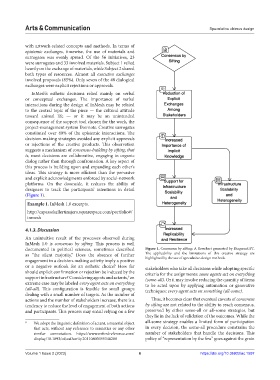
            designers to track the participants’ intentions in detail
            (Figure 1).
             Example 1. InMesh 1.0 excerpts.

             http://capassokellertinajero.squarespace.com/portfolio#/
             inmesh

            4.1.3. Discussion
            An unintuitive result of the processes observed during
            InMesh 1.0 is  consensus by sifting. This process is well
            documented in political sciences, sometimes described   Figure 1. Consensus by sifting: A flowchart generated by DiagramGPT.
            as  “the  silent  majority.”  Does  the  absence  of  further   The applicability and the limitations of this creative strategy are
            engagement in a decision-making activity imply a positive   highlighted by the use of speculative-design methods.
            or a negative outlook  for  an esthetic  choice? How  far   stakeholders who take all decisions while adopting specific
            should explicit confirmation or rejection be induced by the   criteria for the assignments: some agents act on everything
            support infrastructure? Considering agents and actants,  an   (some-all). Or it may involve reducing the quantity of items
                                                       9
            extreme case may be labeled every agent acts on everything   to be acted upon by applying automation or generative
            (all-all). This configuration is feasible for small groups   techniques: every agent acts on something (all-some).
            dealing with a small number of targets. As the number of
            actions and the number of stakeholders increase, there is a   Thus, it becomes clear that eventual caveats of consensus
            tendency to reduce the level of engagement of both actions   by sifting are not related to the ability to reach consensus,
            and participants. This process may entail relying on a few   preserved by either some-all or all-some strategies, but
                                                               they lie in the lack of validation of the outcomes. While the
            9    We adopt the linguistic definition of actant, a material object   all-some strategy enables a limited form of participation
               that acts, without any reference to semiotics or any other   in every decision, the some-all procedure constrains the
               similar connotation. https://www.oxfordreference.com/  number of stakeholders that handle the decisions. This
               display/10.1093/oi/authority.20110803095348288  policy of “representation by the few” goes against the grain


            Volume 1 Issue 2 (2023)                         6                         https://doi.org/10.36922/ac.1597

