


Page 84 - AIH-2-2
P. 84
Artificial Intelligence in Health                                 Efficient knowledge distillation for breast US


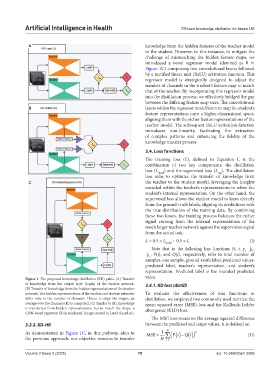
             A                                                 knowledge from the hidden features of the teacher model
                                                               to the student. However, in this instance, to mitigate the
                                                               challenge of mismatching the hidden feature maps, we
                                                               introduced a novel regressor model (denoted as  R in
                                                               Figure 1C) comprising two convolutional layers followed
                                                               by a rectified linear unit (ReLU) activation function. This
                                                               regressor model is strategically designed to adjust the
                                                               number of channels in the student’s feature map to match
                                                               that of the teacher. By incorporating this regressor model
                                                               into the distillation process, we effectively bridged the gap
                                                               between the differing feature map sizes. The convolutional
             B                                                 layers within the regressor model learn to map the student’s
                                                               feature representations onto a higher-dimensional space,
                                                               aligning them with the richer feature representations of the
                                                               teacher model. The subsequent ReLU activation function
                                                               introduces non-linearity, facilitating the extraction
                                                               of complex patterns and enhancing the fidelity of the
                                                               knowledge transfer process.
                                                               3.4. Loss functions

                                                               The training loss (L), defined in Equation I, is the
                                                               combination of two key components: the distillation
                                                               loss (L distill ) and the supervised loss (L ). The distillation
                                                                                              sup
                                                               loss aims to optimize the transfer of knowledge from
             C                                                 the teacher to the student model, leveraging the insights
                                                               encoded within the teacher’s representations to refine the
                                                               student’s internal representation. On the other hand, the
                                                               supervised loss allows the student model to learn directly
                                                               from the ground-truth labels, aligning its predictions with
                                                               the true distribution of the training data. By combining
                                                               these two losses, the training process balances the richer
                                                               signal coming from the internal representation of the
                                                               much larger teacher network against the supervision signal
                                                               from the actual task.
                                                               L = 0.5 × L distill  + 0.5 × L              (I)
                                                                 Note that in the following loss functions  N,  i,  y   ˆ p ,
                                                                                                         i,
                                                                                                            i
                                                               ˆ y ,  P(i), and  Q(i), respectively, refer to total number of
                                                                i
                                                               samples, one sample, ground-truth label, predicted values,
                                                               predicted label, teacher’s representation, and student’s
                                                               representation. Predicted label is the rounded predicted
            Figure 1. The proposed knowledge distillation (KD) paths. (A) Transfer   value.
            of  knowledge  from  the  output layer  (logits) of  the  teacher  network.   3.4.1. KD loss (distill)
            (B) Transfer of knowledge from the hidden representations of the teacher
            network. The hidden representations of the teacher and student networks   To  evaluate  the  effectiveness  of  loss  functions  in
            differ only in the number of channels. Hence, to align the shapes, an   distillation, we employed two commonly used metrics: the
            average over the channels (K) is computed. (C) Similar to (B), knowledge   mean squared error (MSE) loss and the Kullback-Leibler
            is transferred from hidden representations, but to match the shape, a   divergence (KLD) loss.
            CNN-based regressor (R) is employed. Image created in Lucid (lucid.co).
                                                                 The MSE loss measures the average squared difference
            3.3.3. KD-HR                                       between the predicted and target values. It is defined as:
            As demonstrated in  Figure  1C, in this pathway, akin to   MSE   1  N     Pi    2     (II)
                                                                                Qi
            the previous approach, our objective remains to transfer   N  i1

            Volume 2 Issue 2 (2025)                         78                               doi: 10.36922/aih.3509

