


Page 76 - AN-4-4
P. 76
Advanced Neurology                                                     PSG findings in young poor sleepers


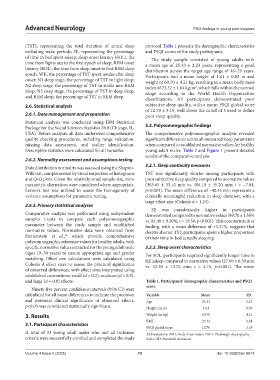
            (TST), representing the total duration of actual sleep   protocol. Table 1 presents the demographic characteristics
            excluding wake periods; SE, representing the percentage   and PSQI scores of the study participants.
            of time in bed spent asleep; sleep onset latency (SOL), the   The  study  sample  consisted  of  young  adults  with
            time from lights out to the first epoch of sleep; REM onset   a mean age of 25.33 ± 2.23 years, representing a good
            latency (ROL), the time from sleep onset to first REM sleep   distribution across the target age range of 18–29 years.
            epoch; WK, the percentage of TST spent awake after sleep   Participants had a mean height of 1.61 ± 0.05  m and
            onset; N1 sleep stage, the percentage of TST in light sleep;   weight of 60.70 ± 4.21 kg, resulting in a mean body mass
            N2 sleep stage, the percentage of TST in stable non-REM   index of 23.32 ± 1.64 kg/m , which falls within the normal
                                                                                    2
            sleep; N3 sleep stage, the percentage of TST in deep sleep;   range according to the World Health Organization
            and REM sleep, the percentage of TST in REM sleep.  classifications. All participants demonstrated poor
            2.6. Statistical analysis                          subjective sleep quality, with a mean PSQI global score
                                                               of 12.70 ± 3.19, well above the cutoff of 5 used to define
            2.6.1. Data management and preparation             poor sleep quality.
            Statistical analysis was conducted using IBM Statistical
            Package for the Social Sciences Statistics 26.0 (Chicago, IL,   3.2. Polysomnographic findings
            USA). Before analysis, all data underwent comprehensive   The comprehensive polysomnographic analysis revealed
            quality checking procedures, including range validation,   significant differences across all measured sleep parameters
            missing  data  assessment,  and  outlier  identification.   when compared to established normative values for healthy
            Descriptive statistics were calculated for all variables.  young adult males. Table 2 and Figure 1 present detailed
                                                               results of the comparative analysis.
            2.6.2. Normality assessment and assumptions testing
            Data distribution normality was assessed using the Shapiro-  3.2.1. Sleep continuity measures
            Wilk test, complemented by visual inspection of histograms   TST was significantly shorter among participants with
            and Q-Q plots. Given the relatively small sample size, non-  poor subjective sleep quality compared to normative values
            parametric alternatives were considered where appropriate.   (363.65 ± 33.10  min vs. 404.10 ± 45.20  min;  t = −7.04,
            Levene’s test was utilized to assess the homogeneity of   p<0.001). The mean difference of −40.45 min represents a
            variance assumptions for parametric testing.       clinically meaningful reduction in sleep duration, with a
                                                               large effect size (Cohen’s d = 1.23).
            2.6.3. Primary statistical analyses
                                                                 SE was paradoxically higher in participants
            Comparative analysis was performed using independent   demonstrated compared to normative values (89.70 ± 1.55%
            samples t-tests to compare each polysomnographic   vs. 84.40 ± 9.30%; t = 19.50, p<0.001). This counterintuitive
            parameter between the study sample and established   finding, with a mean difference of +5.27%, suggests that
            normative  values.  Normative data were  obtained  from   despite shorter TST, participants spent a higher proportion
            Hertenstein  et  al.,   which  provide  comprehensive   of their time in bed actually sleeping.
                             16
            polysomnographic reference values for healthy adults, with
            specific normative values extracted for the young adult male   3.2.2. Sleep onset characteristics
            (ages 19–30 years) to ensure appropriate age and gender   For SOL, participants required significantly longer time to
            matching. Effect size calculations were calculated using   fall asleep compared to normative values (27.60 ± 6.50 min
            Cohen’s d effect sizes to assess the practical significance   vs. 22.20 ± 13.70  min;  t = 4.75,  p<0.001). The mean
            of observed differences, with effect sizes interpreted using
            established conventions: small (d = 0.2), medium (d = 0.5),
            and large (d = 0.8) effects.                       Table 1. Participants’ demographic characteristics and PSQI
                                                               score
              Ninety-five percent confidence intervals (95% CI) were
            calculated for all mean differences to indicate the precision   Variable   Mean               SD
            and potential clinical significance of observed effects.   Age             25.33              2.23
            p<0.05 was considered statistically significant.   Height (in m)           1.61               0.05

            3. Results                                         Weight (in kg)          60.70              4.21
                                                               BMI                     23.32              1.64
            3.1. Participant characteristics
                                                               PSQI global score       12.70              3.19
            A total of 33 young adult males who met all inclusion   Abbreviations: BMI: Body mass index; PSOI: Pittsburgh sleep quality
            criteria were successfully enrolled and completed the study   index; SD: Standard deviation.


            Volume 4 Issue 4 (2025)                         70                               doi: 10.36922/an.8614

