


Page 34 - ARNM-2-3
P. 34
Advances in Radiotherapy
            & Nuclear Medicine                                                        Molecular imaging of lung cancer


            interventions such as surgery resection, chemotherapy,   skeletal muscle, and other organs. CT scanning has been
            and radiotherapy. 6,10,11  Therefore, the detection of   extensively used as the benchmark reference for validating
            subclinical lung cancer and metastases is essential for   alternative field methods in human body compartment
            timely treatment, reducing reoccurrence, and improving   evaluation.  By comparing the topographical images
                                                                        35
            patient stratification.                            obtained from CT scans to cross-sectional areas of
              Surgical lung biopsies, the pathological gold standard   tissues, data show high accuracy and reproducibility in
            for early-stage lung cancer, are very challenging in patients   distinguishing healthy tissue from tumor tissue in mouse
                                                                                        36
            with small nodules. These procedures are invasive,   models with induced tumors.  Routine CT scans are
            prone to high sampling errors, and often associated   applied as a quantitative tool for detecting and monitoring
            with complications.  Computed tomography (CT), the   lung cancer in both clinical settings and preclinical
                            12
            radiological gold standard, is commonly utilized for   animal studies. Major findings show the efficacy of CT
            early lung cancer detection. 6,10,11  However, CT’s accuracy   in detecting lung cancer at an early stage, especially for
            in detecting malignant tumors is limited, as it provides   adenocarcinoma. 37
            minimal molecular-level information about tumor    2.1. Micro-computed tomography (micro-CT) and
            microenvironment (TME) changes related to disease   low-dose CT for non-invasive lung cancer imaging
            invasion, progression, and regression. 13-15  There is an
            urgent, unmet medical need for early and noninvasive   High-resolution micro-CT has emerged as a powerful
            detection of subclinical lung cancer and metastasis, as well   tool for non-invasively visualizing and monitoring lung
            as for monitoring their progression and regression. This   cancer development in live mice. Low-dose computed
            review summarizes current clinical and preclinical studies   tomography (LDCT) has been effectively applied for lung
            to highlight progress (Table 1) and challenges in molecular   cancer screening in humans. CT is effective at both early
            imaging for the early detection of lung cancer, along with   and advanced stages of the disease, as validated against
            their targeting mechanisms.                        traditional histological analysis. Notably, micro-CT can
                                                               distinguish lung tumors as small as 200 µm from healthy
            2. CT                                              tissue in a mouse model with induced tumors. This
                                                               remarkable capability is achieved with a low radiation dose
            CT scans have long been applied to produce high-                                             38
            resolution cross-sectional images, enabling the non-  (0.4 Gy/15 min) and high spatial resolution (15 µm).
            invasive separation, screening, and quantitative assessment   CT primarily targets high-risk patients, placing a
            of various tissue types, including bones, adipose tissue,   significant burden on health-care systems. Although

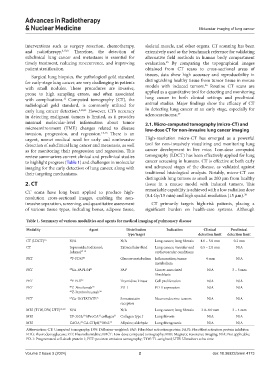
            Table 1. Summary of various modalities and agents for medical imaging of pulmonary disease
            Modality                   Agent           Distribution     Indication      Clinical   Preclinical
                                                       type/target                   detection limit  detection limit
            CT (LDCT) 16       N/A                  N/A            Lung cancer; lung fibrosis  4.0 – 5.0 mm  0.2 mm
            CT                 Iopromide; Iodixanol;   Extracellular fluid  Lung cancer; vascular and   0.5 – 2.0 mm  N/A
                               Iohexol 17-19                       cardiovascular conditions
            PET                18 F-FDG 20          Glucose metabolism  Inflammation; tumor   4 mm   N/A
                                                                   metabolism
            PET                68 Ga-FAPI-04 21     FAP            Cancer-associated     N/A        3 – 5 mm
                                                                   fibroblasts
            PET                18 F-FLT 22          Thymidine kinase  Cell proliferation  N/A        N/A
            PET                89 Z-Nivolumab 23    PD-1           PD-1 expression       N/A         N/A
                               89 Z-Pembrolizumab 24
            PET                68 Ga-DOTATATE 25    Somatostatin   Neuroendocrine tumors  N/A        N/A
                                                    receptors
            MRI (T1W, DW, UTE) 26-29  N/A           N/A            Lung cancer; lung fibrosis  3.0–4.0 mm  3 – 4 mm
            MRI                EP-3533;  hProCA .collagen 31  Collagen type I  Lung fibrosis  N/A    N/A
                                    30
                                           32
            MRI                GdOA;  Gd-CHyd;  MnL 34  Allysine; aldehyde  Lung fibrogenesis  N/A   N/A
                                   32
                                           33
            Abbreviation: CT: Computed tomography; DW: Diffusion-weighted; FAP: Fibroblast activation protein; FAPI: Fibroblast activation protein inhibitor;
            FDG: Fluorodeoxyglucose; FLT: Fluorothymidine; LDCT: Low-dose computed tomography; MRI: Magnetic resonance imaging; N/A: Not applicable;
            PD-1: Programmed cell death protein 1; PET: positron emission tomography; T1W: T1-weighted; UTE: Ultrashort echo time.
            Volume 2 Issue 3 (2024)                         2                              doi: 10.36922/arnm.4173

