


Page 9 - EER-1-1
P. 9
Explora: Environment
            and Resource                                                                    Leaf burning air pollution


            alkanes tended to be higher for leaf as opposed to brush
            burning, with production of C  alkanes being much
                                       27
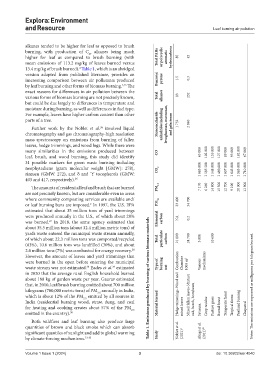
            higher for leaf as compared to brush burning (with      Total PAHs   or polycyclic   aromatic   hydrocarbons  85  45
            mean emissions of 113.2  mg/kg of leaves burned versus
            13.4 mg/kg of brush burned).  Table 1, which is an abridged
                                   2
            version adapted from published literature, provides an
            interesting comparison between air pollutants produced   Benzo(a)  pyrene  1.5  0.3
            by leaf burning and other forms of biomass burning.  The
                                                     2,25
            exact reasons for differences in air pollution between the
            various forms of biomass burning are not precisely known,   Total   alkanes  83  252
            but could be due largely to differences in temperature and
            moisture during burning, as well as differences in fuel type.
            For example, leaves have higher carbon content than other
            parts of a tree.
              Further work by the Noblet  et al.  involved liquid   Monosaccharide   anhydrides including   levoglucosan, mannosan,   and galactosan  1 752  2 040
                                            26
            chromatography and gas chromatography-high resolution
            mass spectroscopy on emissions from burning of fallen
            leaves, hedge trimmings, and wood logs. While there were
            many similarities in the emissions produced between     CO                63 000  102 000  135 000  127 000  89 000  93 000  182 000  67 000
            leaf, brush, and wood burning, this study did identify
            31 possible markers for green waste burning including
            neophytadiene  (gram  molecular  weight  [GMW]:  278),   CO 2             1 663 000  1 585 500  1 548 000  1 489,000  1 637 000  1 643 000  1 563 000  1 710 000
            rimuen (GMW: 272), and  δ and  ϓ tocopherols (GMW:
            403 and 417, respectively). 26
              The amounts of residential leaf and brush that are burned   PM 2.5      7 170  6 260  14 800  15 300  12 700  9 100  20 000  11 900
            are not precisely known, but are considerable even in areas
            where community composting services are available and/
                                       2
            or leaf burning bans are imposed.  In 1997, the U.S. EPA   PM 10  33 400  34 700
            estimated that about 35 million tons of yard trimmings
            were produced annually in the U.S., of which about 28%   Elemental   NA  0.2
            was burned.  In 2018, the same agency estimated that      carbon
                      27
            about 35.5 million tons (about 32.4 million metric tons) of
            yards waste entered the municipal waste stream annually,
            of which about 22.3 million tons was composted/recycled   Total   particulate   carbon  21 800  24 700  3 000  10 600
            (63%), 10.6 million tons was landfilled (30%), and about
            2.6 million tons (7%) was combusted for energy recovery.
                                                         28
            However, the amount of leaves and yard trimmings that
            were  burned  in the  open  before  entering  the  municipal   Type of   burning   Combustion   Chamber   1000 m 3  Various   mechanisms
            waste stream was not estimated.  Eades et al.  estimated    test
                                                 29
                                      28
            in 2020 that the average rural English household burned
            about 180 kg of garden waste per year. Gaurav estimated  Table 1. Emissions produced by burning of various biomass materials
            that, in 2010, leaf/brush burning emitted about 700 million                                     Notes: The emissions are expressed as milligrams per kilogram burned.
            kilograms (700,000 metric tons) of PM  annually in India,
                                          2.5
            which is about 12% of the PM  emitted by all sources in          Hedge trimmings-Wood and   Mixed fallen leaves-Mixture
                                    2.5
            India  (residential  burning  wood,  straw,  dung,  and  coal   Material burned  oak, beech, hornbeam  Temperate forest  Peatland burning
            for  heating  and  cooking  creates  about  57%  of  the  PM       mixed leaves  Crop residue  Pasture grass  Boreal forest  Tropical forest  Chaparral
                                                         2.5
            emitted in the country). 30                                               Savanna
              Both wildfires and leaf burning also produce large
            quantities of brown and black smoke which can absorb
            significant quantiles of sunlight and add to global warming   Study  Noblet et al.   (2021) 2  Akagi et al.   (2011) 25
            by climate-forcing mechanisms. 31-33


            Volume 1 Issue 1 (2024)                         3                                doi: 10.36922/eer.4040

