


Page 8 - EER-2-2
P. 8
Explora: Environment
            and Resource                                                            Scalable nanofluidic photoreceptors


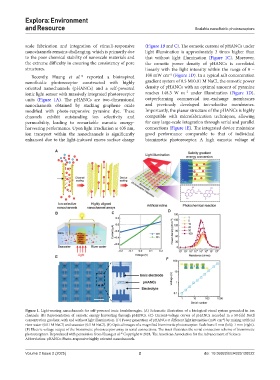
            scale  fabrication  and  integration  of  stimuli-responsive   (Figure 1B and C). The osmotic current of pHANCs under
            nanochannels remains challenging, which is primarily due   light illumination is approximately 3  times higher than
            to the poor chemical stability of nanoscale materials and   that without light illumination (Figure  1C). Moreover,
            the extreme difficulty in ensuring the consistency of pore   the osmotic power density of pHANCs  is correlated
            structures.                                        linearly with the light intensity within the range of 0 –
                                                                         −2
              Recently, Huang  et al.  reported a bioinspired   100 mW cm  (Figure 1D). In a typical salt concentration
                                   16
            nanofluidic photoreceptor constructed with highly   gradient system of 0.5 M/0.01 M NaCl, the osmotic power
            oriented nanochannels (pHANCs) and a self-powered   density of pHANCs with an optimal amount of pyranine
                                                                                −
            ionic light sensor with massively integrated photoreceptor   reaches 148.3 W m ² under illumination (Figure  1D),
            units  (Figure  1A).  The pHANCs  are  two-dimensional   outperforming commercial ion-exchange membranes
            nanochannels obtained by stacking graphene oxide   and previously developed ion-selective membranes.
            modified with photo-responsive pyranine dye. These   Importantly, the planar structure of the pHANCs is highly
            channels exhibit outstanding ion selectivity and   compatible with microfabrication techniques, allowing
            permeability, leading to remarkable osmotic energy-  for easy large-scale integration through serial and parallel
            harvesting performance. Upon light irradiation at 405 nm,   connections (Figure 1E). The integrated device maintains
            ion transport within the nanochannels is significantly   good performance comparable to that of individual
            enhanced due to the light-induced excess surface charge   biomimetic photoreceptor. A  high osmotic voltage of

                         A


                         B                       C                       D


                         E                                              F


            Figure 1. Light-sensing nanochannels for self-powered ionic breakthroughs. (A) Schematic illustration of a biological visual system grounded in ion
            channels. (B) Representation of osmotic energy harvesting through pHANCs. (C) Current-voltage curves of pHANCs recorded in a 50-fold NaCl
                                                                                               −2
            concentration gradient, with and without light illumination. (D) Power generation of pHANCs at different light intensities (mW cm ) by mixing artificial
            river water (0.01 M NaCl) and seawater (0.5 M NaCl). (E) Optical images of a magnified biomimetic photoreceptor. Scale bars: 5 mm (left); 1 mm (right).
            (F) Electric voltage output of the biomimetic photoreceptor array in serial connections. The inset illustrates the serial connection scheme of biomimetic
                                                    16
            photoreceptors. Reproduced with permission from Huang et al.  Copyright © 2024, The American Association for the Advancement of Science.
            Abbreviation: pHANCs: Photo-responsive highly oriented nanochannels.

            Volume 2 Issue 2 (2025)                         2                           doi: 10.36922/EER025120022

