


Page 11 - GHES-1-2
P. 11
Global Health Econ Sustain                                      Self-directed learning supporting mental health


            the article was written in English and whether it originated   2022); student evaluations of transitioned-online courses
            from a peer-reviewed journal. This examination led to the   (Garris & Fleck, 2022); adaptability and high school
            exclusion of three articles not written in English and 17   students’ online learning (Martin et al., 2021); the impact
            articles published in non-peer-reviewed journals, leaving   of learning on science, social and digital literacy (Amina
            a total of 90 articles.                            & Susilo, 2022); factors affecting students’ happiness on
                                                               online learning (Ong et al., 2022); a comparison of online
              To determine the eligibility of the remaining 90 articles,
            the abstracts were scrutinized to determine whether they   learning challenges (Manoharan et al., 2022); “Teachers act
                                                               like we’re robots” (Literat, 2021); and a literature review on
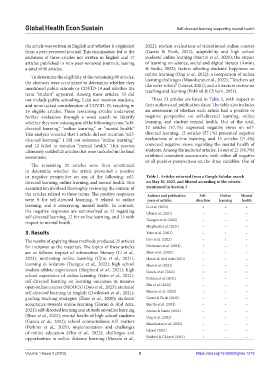
            mentioned public schools or COVID-19 and whether the   teaching and learning (Pokhrel & Chhetri, 2021).
            term “student” appeared. Among these articles, 53 did
            not include public schooling, 2 did not mention students,   These 21 articles are listed in Table 1, with respect to
            and none lacked consideration of COVID-19, resulting in   their authors and publication dates. The table also includes
            35 eligible articles. These remaining articles underwent   an assessment of whether each article had a positive or
            further evaluation through a word search to identify   negative perspective on self-directed learning, online
            whether they were missing any of the following terms: “self-  learning, and student mental health. Out of the total,
            directed learning,” “online learning,” or  “mental  health.”   12 articles (57.1%) expressed negative views on self-
            This analysis revealed that 1 article did not mention “self-  directed learning, 12 articles (57.1%) presented negative
            directed learning,” 1 did not reference “online learning,”   evaluations  of  online  learning,  and  15  articles  (71.4%)
            and 12 failed to mention “mental health.” This process   conveyed negative views regarding the mental health of
            ultimately yielded 21 articles that were included in the final   students. Among the included articles, 14 out of 21 (66.7%)
            assessment.                                        exhibited consistent assessments, with either all negative
                                                               or all positive perspectives on the three variables. Out of
              The remaining 21 articles were then scrutinized
            to  determine  whether  the  article  presented  a  positive
            or negative perspective on any of the following: self-  Table 1. Articles returned from a Google Scholar search
            directed learning, online learning, and mental health. This   on May 30, 2023, and filtered according to the criteria
            examination involved thoroughly reviewing the content of   mentioned in Section 3
            the articles related to these terms. The positive responses   Authors and publication   Self‑   Online   Mental
            were 9 for self-directed learning, 9 related to online   years of articles   direction  learning  health
            learning,  and  6  concerning  mental  health.  In  contrast,   Li et al. (2023)   +  +      +
            the negative responses are summarized as 12 regarding   Chiu et al. (2021)  +        –        –
            self-directed learning, 12 for online learning, and 15 with
            respect to mental health.                          Tacogue et al. (2022)   –         –        –
                                                               Shepherd et al. (2021)  –         –        –
            3. Results                                         Yates et al. (2021)     –         +        –
            The results of applying these methods produced 21 articles   Doo et al. (2022)  +    +       +
            for inclusion as the materials. The topics of these articles   Dwilestari et al. (2021)  +  –  +
            are as follows: impact of information literacy (Li  et al.,   Zhao et al. (2020)  +  +       +
            2023); motivating online learning (Chiu  et al., 2021);   Harun & Abd Aziz (2021)  –  +       –
            learning in isolation (Tacogue  et al., 2022); high school   Shao et al. (2022)  –   –        –
            student-athlete experiences (Shepherd et al., 2021); high   Garcia et al. (2022)  +  +       +
            school experience of online learning (Yates et al., 2021);   Perkins et al. (2021)  –  –      –
            self-directed learning on learning outcomes in massive
            open online courses (MOOCs) (Doo et al., 2023); students’   Zhu et al. (2022)  –     –        –
            self-directed learning in English (Dwilestari et al., 2021);   Manalo et al. (2022)  +  +     –
            guiding teaching strategies (Zhao  et al., 2020); students’   Garris & Fleck (2022)  –  –     –
            acceptance towards online learning (Harun & Abd Aziz,   Martin et al. (2021)  –      +        –
            2021); self-directed learning and attitude on online learning   Amina & Susilo (2022)  –  –   –
            (Shao et al., 2022); mental health of high school students   Ong et al. (2022)  +    +       +
            (Garcia  et al., 2022); school connectedness still matters   Manoharan et al. (2022)  –  –    –
            (Perkins  et al.,  2021);  implementation and  challenges
            of online education (Zhu  et al., 2022); challenges and   Literat (2021)   –         –        –
            opportunities in online distance learning (Manalo et al.,   Pokhrel & Chhetri (2021)  +  –    –


            Volume 1 Issue 2 (2023)                         5                        https://doi.org/10.36922/ghes.1219

