


Page 12 - GHES-2-1
P. 12
Global Health Econ Sustain                                          Hypnosis: Refiguring health care practice


            4. Unenforceable prohibition                       Report                 Command

            4.1. Misperception about hypnosis                  Content                Relationship
            The assumption that hypnosis could be prohibited represents   Information  How this information is to be taken
            a misconception about hypnosis. To understand this   What is expressed    How it is expressed
            misconception, it is necessary to examine the phenomenon   Figure 1. The report and command aspects of communication.
            of hypnosis more closely. Hypnosis involves the occurrence of
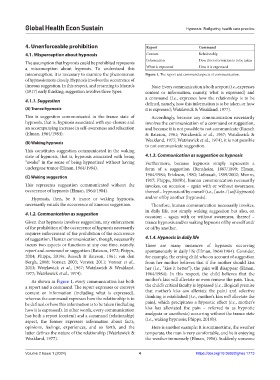
            timeous suggestion. In this respect, and returning to Munro’s   Note: Every communication is both a report (i.e., expresses
            (1917) early thinking, suggestion involves three types.  content or information, namely, what is expressed) and
                                                               a command (i.e., expresses how the  relationship is to be
            4.1.1. Suggestion
                                                               defined, namely, how this information is to be taken, or how
            (A) Trance hypnosis                                it is expressed; Watzlawick & Weakland, 1977).
            This is suggestion communicated in the trance state of   Accordingly, because any communication necessarily
            hypnosis, that is, hypnosis associated with eye-closure and   involves the communication of a command or suggestion,
            an accompanying increase in self-awareness and relaxation   and because it is not possible to not communicate (Ruesch
            (Elman, 1964/1984).                                & Bateson, 1961;  Watzlawick  et al., 1967; Watzlawick &
                                                               Weakland, 1977; Watzlawick et al., 1974), it is not possible
            (B) Waking hypnosis
                                                               to not communicate suggestion.
            This constitutes suggestion communicated in the waking
            state of hypnosis, that is, hypnosis associated with being   4.1.3. Communication as suggestion as hypnosis
            “awake” in the sense of being hypnotized without having   Furthermore, because hypnosis simply represents a
            undergone trance (Elman, 1964/1984).               form of a suggestion (Bernheim, 1887/1899; Elman,
                                                               1964/1984; Erickson, 1980; Liébeault, 1889/2002; Munro,
            (C) Waking suggestion
                                                               1917; Phipps, 2019b), human communication necessarily
            This represents suggestion communicated without the   invokes, on occasion – again with or without awareness,
            occurrence of hypnosis (Elman, 1964/1984).         thereof – hypnosis of/by oneself (i.e., [auto-/] self-hypnosis)
              Hypnosis, then, be it trance or waking hypnosis,   and/or of/by another (hypnosis).
            necessarily entails the occurrence of timeous suggestion.  Therefore, human communication necessarily invokes,
                                                               in daily life, not simply waking suggestion but also, on
            4.1.2. Communication as suggestion
                                                               occasion – again with or without awareness, thereof –
            Given that hypnosis involves suggestion, any enforcement   trance hypnosis and/or waking hypnosis of/by oneself and/
            of the prohibition of the occurrence of hypnosis necessarily   or of/by another.
            requires enforcement of the prohibition of the occurrence
            of suggestion. Human communication, though, necessarily   4.1.4. Hypnosis in daily life
            incurs two aspects or functions at any one time, namely,   There are many instances of hypnosis occurring
            report and command or suggestion (Bateson, 1972; Phipps,   spontaneously in daily life (Elman, 1964/1984). Consider,
            2004; Phipps, 2019a; Ruesch & Bateson, 1961; van den   for example, the crying child who on account of suggestion
            Bergh, 2008; Vorster, 2003; Vorster, 2011; Vorster  et al.,   from her mother believes that if the mother should kiss
            2013; Watzlawick  et  al., 1967; Watzlawick & Weakland,   her (i.e., “kiss it better”), the pain will disappear (Elman,
            1977; Watzlawick et al., 1974).                    1964/1984).  In  this respect,  the  child  believes  that  the
              As shown in Figure 1, every communication has both   mother’s kiss will alleviate or even remove the pain. Thus,
            a report and a command. The report expresses or conveys   the child’s critical faculty is bypassed (i.e., illogical premise
            content or information (including what is expressed),   that  mother’s  kiss  can  alleviate the  pain)  and selective
            whereas the command expresses how the relationship is to   thinking is established (i.e., mother’s kiss will alleviate the
            be defined or how this information is to be taken (including   pain), which precipitates a hypnotic effect (i.e., mother’s
            how it is expressed). In other words, every communication   kiss  has alleviated the pain – referred to as hypnotic
            has both a report (content) and a command (relationship)   analgesia or anesthesia) occurring without the trance state
            aspect, the former expresses information about facts,   (i.e., waking hypnosis; Phipps, 2019b).
            opinions,  feelings,  experiences,  and  so  forth,  and  the   Here is another example: It is summertime, the weather
            latter defines the nature of the relationship (Watzlawick &   temperate, the man is very comfortable, and he is enjoying
            Weakland, 1977).                                   the weather immensely (Elman, 1956). Suddenly someone


            Volume 2 Issue 1 (2024)                         4                        https://doi.org/10.36922/ghes.1713

