


Page 128 - GHES-3-3
P. 128
Global Health Economics and
            Sustainability
                                                                          Challenges of emerging MH researchers in Africa


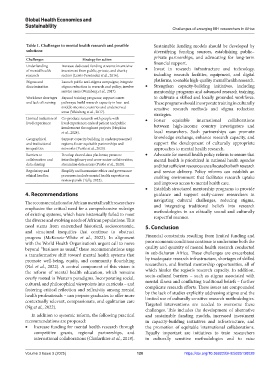
            Table 1. Challenges in mental health research and possible   Sustainable funding models should be developed by
            solutions                                             diversifying funding sources, establishing public–
                                                                  private  partnerships,  and  advocating  for  long-term
            Challenges              Strategy for action           financial support.
            Underfunding   Increase dedicated funding streams; incentivize   •   Invest in research infrastructure and technology,
            of mental health   investment from public, private, and charity
            research       sectors (Lewis-Fernández et al., 2016).  including research facilities, equipment, and digital
            Stigma and     Launch public anti-stigma campaigns; integrate   platforms, to enable high-quality mental health research.
            discrimination  stigma reduction in research and policy; involve   •   Strengthen capacity-building initiatives, including
                           service users (Wainberg et al., 2017).  mentorship programs and advanced research training,
            Workforce shortages  Expand training programs; support career   to cultivate a skilled and locally grounded workforce.
            and lack of training  pathways; build research capacity in low- and   These programs should incorporate training in culturally
                           middle-income countries and underserved   sensitive research methods and stigma reduction
                           areas (Wainberg et al., 2017).
                                                                  strategies.
            Limited inclusion of   Co-produce research with people with   •   Foster  equitable  international  collaborations
            lived experience  lived experience; embed patient and public
                           involvement throughout projects (Hopkins    between high-income country investigators and
                           et al., 2024).                         local researchers. Such partnerships can promote
            Geographical   Support capacity building in underrepresented   knowledge exchange, enhance research capacity, and
            and institutional   regions; foster equitable partnerships and   support the development of culturally appropriate
            inequalities   networks (Purtle et al., 2020).        approaches to mental health research.
            Barriers to    Develop shared data platforms; promote   •   Advocate for mental health policy reform to ensure that
            collaboration and   interdisciplinary and cross-sector collaboration;   mental health is prioritized in national health agendas
            data sharing   streamline data access (Purtle et al., 2020).  and that sufficient resources are allocated to both research
            Regulatory and   Simplify and harmonize ethics and governance   and  service  delivery.  Policy  reforms  can  establish  an
            ethical hurdles  processes; include mental health expertise on   enabling environment that facilitates research uptake
                           review panels (Tully, 2022).
                                                                  and improves access to mental health care.
                                                               •   Establish structured mentorship programs to provide
            4. Recommendations                                    guidance and support early-career researchers in
            The recommendations for African mental health researchers   navigating cultural challenges, reducing stigma,
            emphasize the critical need for a comprehensive redesign   and integrating traditional beliefs into research
                                                                  methodologies in an ethically sound and culturally
            of existing systems, which have historically failed to meet   respectful manner.
            the diverse and evolving needs of African populations. This
            need stems from entrenched historical, socioeconomic,   5. Conclusion
            and structural inequities that continue to obstruct
            progress (McKenzie-White  et al., 2022). In alignment   Financial constraints resulting from limited funding and
            with the World Health Organization’s urgent call to move   poor economic conditions continue to undermine both the
            beyond “business as usual,” these recommendations urge   quality and quantity of mental health research conducted
            a transformative shift toward mental health systems that   in sub-Saharan Africa. These challenges are exacerbated
            promote  well-being,  equity,  and  community  flourishing   by inadequate research infrastructure, shortages of skilled
            (Nel  et  al., 2022). A  central component of this vision is   researchers, and limited mentorship opportunities, all of
            the  reform  of  mental  health  education,  which  remains   which hinder the region’s research capacity. In addition,
            overly rooted in Western paradigms. Incorporating social,   socio-cultural  barriers  –  such  as  stigma  associated  with
            cultural, and philosophical viewpoints into curricula – and   mental illness and conflicting traditional beliefs – further
            fostering critical reflection and reflexivity among mental   complicate research efforts. These issues are compounded
            health professionals – can prepare graduates to offer more   by the lack of studies explicitly addressing stigma and the
            contextually relevant, compassionate, and egalitarian care   limited use of culturally sensitive research methodologies.
                                                               Targeted interventions are needed to overcome these
            (Ng et al., 2022).
                                                               challenges. This  includes  the development of  alternative
              In addition to systemic reform, the following practical   and sustainable funding models, increased investment
            recommendations are proposed:                      in  capacity-building  initiatives  and  infrastructure,  and
            •   Increase funding for mental health research through   the promotion of equitable international collaborations.
               competitive grants, regional partnerships, and   Equally important are initiatives to train researchers
               international collaborations (Chidarikire et al., 2018).   in culturally sensitive methodologies and to raise


            Volume 3 Issue 3 (2025)                        120                 https://doi.org/10.36922/GHES025130028

