


Page 8 - GTM-2-2
P. 8
Global Translational Medicine                                                  Clinical algorithms in ART


            1. Introduction                                    born  of  Luise  Brown,  Robert  Edwards’s  first  successful
                                                               human application of this procedure . An IVF program
                                                                                             [5]
            Artificial intelligence (AI) in medical issues management   is divided into four separate phases, each responsible,
            can improve the accuracy, efficiency, and effectiveness of   at different percentages, for the final result: Controlled
            health-care delivery, leading to better patient outcomes   ovarian stimulation (COS) to obtain multiple oocytes [6,7] ,
            and improved public health. AI leads to deep analysis of   laboratory  treatments  for  fertilization ,  embryo
                                                                                                   [8]
            complex systems detection and to building up provisions   differentiation , and ET . Key performance index (KPI)
                                                                          [9]
                                                                                  [10]
            to prospectively manage dynamic changes in our society.   detects optimal single-step performance compared with
            The future fertility outcomes are a key input to estimating   good medical and laboratory standard procedures leading
            future population size, depending on the social custom   to optimizing chances of implantation and live birth [11,12] .
            and economic safe of populations of different countries.
            Population size and age structure modifications might have   The  gold  standard  of  the  single  steps  of  this  procedure
            dramatic economic, social, and geopolitical impacts in   is now entering the era of being managed by AI rather
            many countries. On the other hand, forecasting mortality,   than  human  controls.  However,  there  have  been  mixed
            fertility, infertility treatments, migration, and population   results, presented with some positive evidence and some
            are the necessary prerequisite for the sustainable   ineffective applications. To optimize the results, periodic
            development of the human condition. Infertility, defined   internal and external checks of these KPIs are essential.
            as a failure to achieve pregnancy after 1  year of regular   This has already been established as a standard by various
            unprotected sexual intercourse, affects 8.8% of US women   registers in the world, and reports are sent for diagnosis
                                                                                                           [13]
                          [1]
            aged 15 – 49 years  and is often associated with significant   of various parameters such as entry, age of the partners ,
            psychological distress .                           type of therapeutic approach, supply of gametes, and
                             [2]
                                                               accessory pathologies .
                                                                                [14]
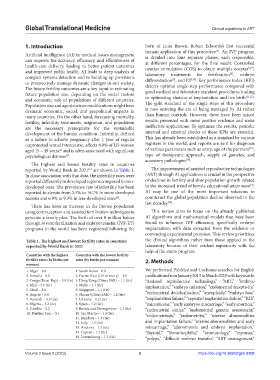
              The highest and lowest fertility rates in countries
                                       [3]
            reported by World Bank in 2021  are shown in Table 1.   The improvement of assisted reproductive technologies
            In close association with that data, the infertility rates were   (ART) through AI applications is crucial in the perspective
            reported differently in developed regions compared to non-  of declines in fertility and slow population growth related
                                                                                                           [4]
            developed ones. The prevalence rate of infertility has been   to the increased trend of female educational attainment .
            reported to elevate from 3.5% to 16.7% in more developed   AI may be one of the most important solutions to
                                                  [4]
            nations and 6.9% to 9.3% in less-developed ones .  counteract the global population decline observed in the
                                                               last decades .
                                                                        [15]
              There has been an increase in the literate population
            using contraception and assisted fertilization techniques to   This review aims to focus on the already published
            generate a family plan. The birth of over 8 million babies   AI  algorithms  and  mathematical  models  that  have  been
            through in vitro fertilization and embryo transfer (IVF-ET)   found to  influence  IVF efficiency, specifically embryo
            programs in the world has been registered following the   implantation, with data extracted from the evidence or
                                                               convincing experimental promises. This review prioritizes
            Table 1. The highest and lowest fertility rates in countries   the clinical algorithms rather than those applied in the
            reported by World Bank in 2021                     laboratory because of their evident superiority with the
                                                               help of the entire program.
            Countries with the highest   Countries with the lowest fertility
            fertility rates (by births per   rates (by births per woman)  2. Methods
            woman)
            1. Niger – 6.8       1. South Korea – 0.9          We performed PubMed and Cochrane searches for English
            2. Somalia – 6.0     2. Puerto Rico (US territory) – 1.0  publications from January 2013 to March 2023 with keywords:
            3. Congo (Dem. Rep.) – 5.8 (tie) 3. Hong Kong (China SAR) – 1.1 (tie)  “Assisted reproductive technology,” “ART,” “embryo
            4. Mali – 5.8 (tie)  4. Malta – 1.1 (tie)          implantation,” “embryo nidation,” “endometrial receptivity,”
            5. Chad – 5.6        5. Singapore – 1.1 (tie)      “endometrial decidualization,” “aneuploidy,” “embryo loss,”
            6. Angola – 5.4      6. Macau (China SAR) – 1.2 (tie)
            7. Burundi – 5.3 (tie)  7. Ukraine – 1.2 (tie)     “implantation failure,” “repeated implantation failure,” “RIF,”
            8. Nigeria – 5.3 (tie)  8. Spain – 1.2 (tie)       “microbiome,” “early embryos miscarriage,” “early abortion,”
            9. Gambia – 5.2      9. Bosnia and Herzegovina – 1.3 (tie)  “endometrial omics,” “endometrial genetic assessment,”
            10. Burkina Faso – 5.1  10. San Marino – 1.3 (tie)  “endometriosis,”  “endometritis,”  “uterine  abnormalities
                                 11. Moldova – 1.3 (tie)
                                 12. Italy – 1.3 (tie)         and implantation failure,” “uterine abnormalities and early
                                 13. Andorra – 1.3 (tie)       miscarriage,” “adenomyosis and embryo implantation,”
                                 14. Cyprus – 1.3 (tie)        “thyroid,” “thrombophilia,” “immunology,” “myomas,”
                                 15. Luxembourg – 1.3 (tie)    “polyps,”  “difficult  embryo  transfer,”  “ART  management,”


            Volume 2 Issue 2 (2023)                         2                        https://doi.org/10.36922/gtm.0308

