


Page 533 - IJB-10-2
P. 533
International Journal of Bioprinting                                    3D printing of custom mallet splints


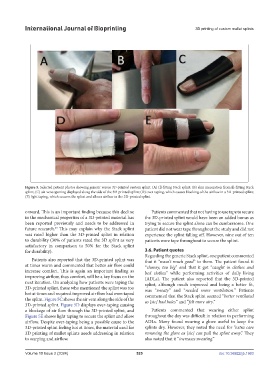
            Figure 5. Selected patient photos showing generic versus 3D-printed custom splint. (A) Ill-fitting Stack splint; (B) skin maceration from ill-fitting Stack
            splint; (C) air-vent opening displayed along the side of the 3D-printed splint; (D) over-taping, which causes blocking of the airflow in a 3D-printed splint;
            (E) light taping, which secures the splint and allows airflow in the 3D-printed splint.


            onward. This is an important finding because this decline   Patients commented that not having to use tape to secure
            in the mechanical properties of a 3D-printed material has   the 3D-printed splint would have been an added bonus as
            been reported previously and needs to be addressed in   trying to secure the splint alone can be cumbersome. One
                         29
            future  research.  This  may explain why the  Stack  splint   patient did not wear tape throughout the study and did not
            was rated higher than the 3D-printed splint in relation   experience the splint falling off. However, nine out of ten
            to durability (30% of patients rated the 3D splint as very   patients wore tape throughout to secure the splint.
            satisfactory  in  comparison  to  50% for  the  Stack  splint
            for durability).                                   3.6. Patient quotes
                                                               Regarding the generic Stack splint, one patient commented
               Patients also reported that the 3D-printed splint was   that it “wasn’t much good” to them. The patient found it
            at times warm and commented that better air flow could   “clumsy, too big” and that it got “caught in clothes and
            increase comfort. This is again an important finding as   bed clothes” while performing activities of daily living
            improving airflow, thus comfort, will be a key focus on the   (ADLs). The patient also reported that the 3D-printed
            next iteration. On analyzing how patients were taping the   splint, although much improved and being a better fit,
            3D-printed splint, those who mentioned the splint was too   was  “sweaty”  and “needed more ventilation.”  Patients
            hot at times and required improved air flow had over-taped   commented that the Stack splint seemed “better ventilated
            the splint. Figure 5C shows the air vent along the side of the   as [sic] had holes” and “felt more airy.”
            3D-printed splint. Figure 5D displays over-taping causing
            a blockage of air flow through the 3D-printed splint, and   Patients commented that wearing either splint
            Figure 5E shows light taping to secure the splint and allow   throughout the day was difficult in relation to performing
            airflow. Despite over-taping being a possible cause to the   ADLs. Many found wearing a glove useful to keep the
            3D-printed splint feeling hot at times, the material used for   splints dry. However, they noted the need for “extra care
            3D printing of mallet splints needs addressing in relation   removing the glove as [sic] can pull the splint away.” They
            to warping and airflow.                            also noted that it “increases sweating.”


            Volume 10 Issue 2 (2024)                       525                                doi: 10.36922/ijb.1963

