


Page 9 - ITPS-7-4
P. 9
INNOSC Theranostics and
            Pharmacological Sciences                                          The Takotsubo syndrome: A gender disparity


            to be affected by emotional events.  By breaking down   as a result of this illness. The elevated catecholamine
                                         22
            the total number of TTS cases by gender, it is possible to   level is thought to be the cause of the left ventricular
            determine that the notable variation in TTS prevalence   dysfunction, electrocardiogram abnormalities, band
            between men and women is also a result of the social   necrosis, and hypercontraction of sarcomas that are
            standing and roles that women play in various nations and   indistinguishable from TTS. 36
            cultures. These triggers can happen alone or in combination;   (ii)  Coronary artery disease (CAD), which has a
            for example, a panic attack or an emotional event that   prevalence of 10 – 29%, is frequently linked to TTS.
            follows surgery or an accident can trigger anxiety.   According to some theories, CAD and TTS coexist
                                                                  or CAD even act as a trigger for the development of
            2.1.1. Stressors on an emotional level                TTS. 37-39
            Anxiety, fear, anger, earthquakes, floods, interpersonal
            conflicts, and traumatic experiences are just a few   3. Gender disparities in TTS
            examples of the wide range of emotions and situations that   When comparing the gender distribution of TTS cases in
            can be described as “stressors”. 23-26  An important aspect   the USA, Europe, and Japan, it is important to note that
            of this process is the identification of psychological and   while  the  percentage  of  male  cases  varies  from  study  to
            psychosocial stressors. There is very little information about   study, TTS affects women more often than men.  Of note,
                                                                                                     40
            the living conditions of patients with TTS at the moment.   TTS affects particularly postmenopausal women. 40
            The study by Wallstrom et al.  examined the psychological
                                   21
            and  psychosocial  stress  experienced  by  postmenopausal   This is in opposition to how the illness manifests itself:
            women. Many of the patients reported that they felt   accumulating evidence points out that men are frequently
            burdened by responsibility, injustice, and uncertainty long   more severely affected by TTS than women. Taking into
            before the onset of TTS. The respondents’ defenses were   account the gender disparities in the USA, Europe, and
            so weakened by this prolonged stress that even minor   Japan, recent reports suggest that women tend to respond
            stressors could cause them to lose their equilibrium. The   more to emotional stressors, while men respond primarily
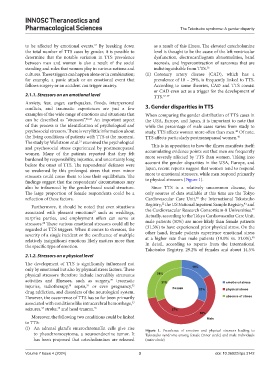
            findings suggest that the respondents’ circumstances may   to physical stressors (Figure 1).
            also be influenced by the gender-based social structure.   Since TTS is a relatively uncommon disease, the
            The large proportion of female respondents could be a   only sources of data available at this time are the Tokyo
            reflection of these factors.                       Cardiovascular Care Unit,  the International Takotsubo
                                                                                    40
                                                                                                         41
                                                                      22
              Furthermore, it should be noted that even situations   Registry,  the US National Inpatient Sample Registry,  and
                                                                                                            42
            associated  with  pleasant  emotions   such  as  weddings,   the Cardiovascular Research Consortium-8 Universities.
                                         27
            surprise parties, and employment offers can serve as   Actually, according to the Tokyo Cardiovascular Care Unit,
            stressors.  These various emotional stressors could all be   male patients (50%) are more likely than female patients
                   28
            regarded as TTS triggers. When it comes to stressors, the   (31.3%) to have experienced prior physical stress. On the
            severity of a single incident or the confluence of multiple   other hand, female patients experience emotional stress
                                                                                                            40
            relatively insignificant emotions likely matters more than   at a higher rate than male patients (19.0% vs. 31.0%).
            the specific type of emotion.                      In  detail,  according  to  reports  from  the  International
                                                               Takotsubo Registry, 29.2% of females and about 14.5%
            2.1.2. Stressors on a physical level
            The development of TTS is significantly influenced not
            only by emotional but also by physical stress factors. These           16%
            physical stressors therefore include incredibly strenuous   28%
            activities and illnesses, such as surgery,  traumatic     31%                        emotional stress
                                                29
            injuries, radiotherapy,  sepsis,  or even pregnancy,          Female
                                      31
                                                         32
                              30
            drug addiction, and disorders of the neurological system.                 32%        physical stress
            However, the occurrence of TTS has so far been primarily                             absence of stress
            associated with conditions like intracerebral hemorrhage,
                                                         33
            seizures,  stroke,  and head trauma. 35                       37%
                          29
                   34
                                                                                      56%
              Moreover, the following two conditions could be linked                     Male
            to TTS:
            (i)  An adrenal gland’s enterochromaffin cells give rise   Figure  1. Prevalence  of emotion and physical stressors leading to
               to pheochromocytoma, a neuroendocrine tumor. It   Takotsubo syndrome among female (inner circle) and male individuals
               has  been proposed  that catecholamines  are released   (outer circle)
            Volume 7 Issue 4 (2024)                         3                                doi: 10.36922/itps.3142

