


Page 20 - JCAU-6-1
P. 20
Journal of Chinese
            Architecture and Urbanism                                Spatial exploration through image semantic segmentation


            2.2. Overview of semantic segmentation’s           several applications in construction personnel management,
            applications in urban spaces                       edge protection safety management, and construction site
            Semantic segmentation finds extensive applications in image   vehicle management are rooted in computer vision (Gao
            processing, holding wide-ranging potential applications in   et al., 2022; Gerhard et al., 2018; Zhang et al., 2021).
            urban spaces. Common fields of application encompass urban   2.3. Data collection and pre-processing
            planning, traffic management, environmental monitoring,
            and cultural heritage preservation, among others. Currently,   2.3.1. Collection of street image data of Lu Xun’s
            the overall application is undergoing rapid development   hometown
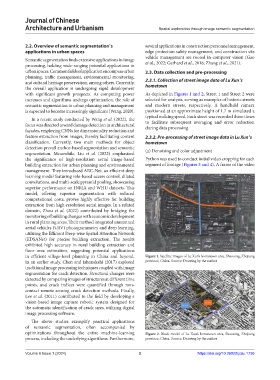
            with significant growth prospects. As computing power   As depicted in Figures 1 and 2, Street 1 and Street 2 were
            increases and algorithms undergo optimization, the role of   selected for analysis, serving as examples of historic streets
            semantic segmentation in urban planning and management   and modern streets, respectively. A  handheld camera
            is expected to become increasingly significant (Wang, 2020).  positioned at an approximate height of 1.7 m simulated a
                                                               typical walking speed. Each street was recorded three times
              In a recent study conducted by Wang et al. (2022), the
            focus was directed toward damage detection in architectural   to facilitate subsequent averaging and error reduction
                                                               during data processing.
            façades, employing CNNs for dimensionality reduction and
            feature extraction from images, thereby facilitating content   2.3.2. Pre-processing of street image data in Lu Xun’s
            classification. Currently, two main methods for object   hometown
            detection prevail anchor-based segmentation and semantic
            segmentation. Meanwhile, Liu  et al.  (2022)  emphasized   (a) Denoising and color adjustment
            the significance of high-resolution aerial image-based   Python was used to conduct initial video cropping for each
            building extraction for urban planning and environmental   segment of footage (Figures 3 and 4). A frame of the video
            management. They introduced ARC-Net, an efficient deep
            learning model featuring role-based access control, dilated
            convolutions, and multi-scale pyramid pooling, showcasing
            superior performance on INRIA and WHU datasets. This
            model,  offering  superior  segmentation  with  reduced
            computational costs, proves highly effective for building
            extraction from high-resolution aerial images. In a related
            domain, Zhou  et al. (2022)  contributed by bridging the
            monitoring of building changes with economic development
            in rural planning areas. Their method integrated unmanned
            aerial vehicles (UAV) photogrammetry and deep learning,
            utilizing the Efficient Deep-wise Spatial Attention Network
            (EDSANet) for precise building extraction. The results
            exhibited  high  accuracy  in  rural  building  extraction  and
            floor area estimation, suggesting potential applications
            in efficient village-level planning in China and beyond.   Figure 1. Satellite images of Lu Xun’s hometown area, Shaoxing, Zhejiang
            In an earlier study, Chen and Jahanshahi (2017) explored   province, China. Source: Drawing by the author
            traditional image processing techniques coupled with image
            segmentation for crack detection. Structural changes were
            detected by comparing images of structures at different time
            points, and crack indices were quantified through non-
            contact remote sensing crack detection methods. Finally,
            Lee et al. (2011) contributed to the field by developing a
            vision-based image capture robotic system designed for
            the automatic identification of crack sizes, utilizing digital
            image processing software.

              The above studies exemplify practical applications
            of semantic segmentation, often accompanied by
            optimizations throughout the entire machine-learning   Figure 2. Block model of Lu Xun’s hometown area, Shaoxing, Zhejiang
            process, including the underlying algorithms. Furthermore,   province, China. Source: Drawing by the author


            Volume 6 Issue 1 (2024)                         3                        https://doi.org/10.36922/jcau.1736

