


Page 61 - JCAU-6-3
P. 61
Journal of Chinese
            Architecture and Urbanism                                           Age-friendly smart communities in Beijing


            Table 1. A summary of metrics relevant to age-friendly smart community
            Characteristics                                           Definition
            Proportion of the elderly population  Percentage of elderly population in the age above 65 years old
            Housing price              Average housing listing price within the spatial grid cell
            Urban centrality           Degree of center in Beijing (the closer to the center, the higher the value)
            House age                  Average building age according to the built year
            Service                    Beauty salons (27,929), maintenance sites (4,057), photo studios (4,021), laundromats (3,473),
                                       telecommunication business halls (2,938), post offices (928), moving companies (419), home appliance and
                                       electronic outlets (114), and other services (164)
            Commerce                   Supermarkets (6,447), malls (890), convenience stores/convenience stores (151), and other commerces (62)
            Cultural amenities         Science, education and cultural venues (20,314), training institutions (14,197), schools (11,500), scientific
                                       research institutions (4,382), media organizations (3,139), exhibition centers (1,501), libraries (629), art
                                       galleries (593), exhibition halls (586), cultural palace (526), museums (260), driving schools (225), art groups
                                       (198), archives (92), companies (72), specialty stores (60), science and technology museums (51), government
                                       agencies (31), and other cultural amenities (139)
            Leisure facilities         Sports venues (10,203), sports venues (8,494), entertainment venues (5,441), sports and leisure services
                                       (4,748), holiday resorts (1,375), cinemas (602), golf (170), Chinese restaurants (52), accommodation services
                                       (47), and other leisure facilities (135)
            Healthcare                 Pharmaceutical and health-care outlets (8,002), health-care service establishments (5,233), clinics (3,739),
                                       general hospitals (2,815), specialized hospitals (2,471), animal healthcare establishments (763), disease
                                       prevention institutions (135), and emergency centers (119)
            Transit                    Parking lots (56,970), bus stations (14,431), subway stations (675), long-distance bus stations (98), and train
                                       stations (70)
            Food                       Chinese restaurants (56,490), snack bars (10,403), foreign restaurants (3,569), casual restaurants (330), and
                                       other food services (216)
            Public service             Public toilets (15,716)
            Governance and organization  Government agencies (23,879), social organizations (8,102), public security agencies (6,078), government
                                       and social organizations (5,552), industrial and commercial tax agencies (1,201), traffic vehicle management
                                       (563), foreign organizations (536), democratic parties (63), and other organizations (42)

                         A                 B                 C                D


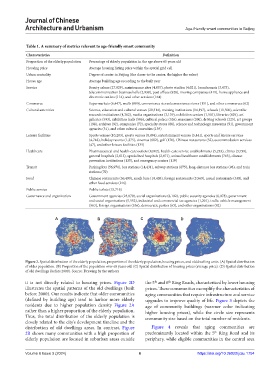
            Figure 2. Spatial distribution of the elderly population, proportion of the elderly population, housing prices, and old dwelling units. (A) Spatial distribution
            of older population. (B) Proportion of the population over 65 years old. (C) Spatial distribution of housing prices (average price). (D) Spatial distribution
            of old dwellings (before 2000). Source: Drawing by the authors

            it is not directly related to housing prices.  Figure  2D   the 5  and 6  Ring Roads, characterized by lower housing
                                                                         th
                                                                   th
            illustrates the spatial patterns of the old dwellings (built   prices. These communities exemplify the characteristics of
            before 2000). Our results indicate that older communities   aging communities that require infrastructure and service
            (defined  by  building  age) tend  to  harbor  more  elderly   upgrades to improve quality of life. Figure 3 depicts the
            residents due to higher population density  Figure 2A   age of community buildings (warmer color indicating
            rather than a higher proportion of the elderly population.   higher housing prices), while the circle size represents
            Thus, the total distribution of the elderly population is   community size based on the total number of residents.
            closely related to the city’s development timeline and the
            distribution  of  old  dwellings  areas.  In  contrast,  Figure   Figure  4 reveals that aging communities are
            2B shows many communities with a high proportion of   predominantly located within the 5   Ring Road and its
                                                                                            th
            elderly population are located in suburban areas outside   periphery, while eligible communities in the central area

            Volume 6 Issue 3 (2024)                         6                        https://doi.org/10.36922/jcau.1754

