


Page 24 - JCBP-3-3
P. 24
Journal of Clinical and
            Basic Psychosomatics                                               Utilizing hypnosis to cope with fibromyalgia


              While ACE is a crucial factor in clinical practice,
            patients may not readily acknowledge traumatic events
            that could contribute to the development of FMS. This
            may be due to a tendency to minimize or suppress such
            experiences or due to alexithymia, a personality trait that
            hinders the verbalization of emotions and understanding
            of the connection between emotional events and physical
            distress. 13
              Consciously, only a small fraction of patients may
            report traumatic events linked to the disease. This may
            be attributed to difficulties in elaborating on traumatic
            experiences. In a study by De Almeida-Marques et al., 32
                                                       30
            women at a primary care center were interviewed twice,
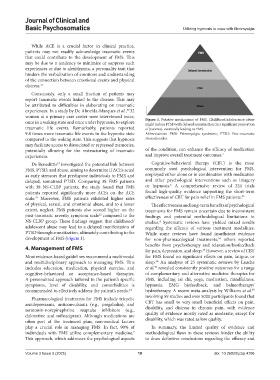
            once in a waking state and once under hypnosis, to explore   Figure  1.  Putative mechanisms of FMS.  Childhood/adolescence abuse
                                                               might induce PTSD with delayed somatization (in a significant proportion
            traumatic life events. Remarkably, patients reported   of patients), eventually leading to FMS.
            9.8 times more traumatic life events in the hypnotic state   Abbreviations: FMS: Fibromyalgia syndrome; PTSD: Post-traumatic
            compared to the waking state. This suggests that hypnosis   stress disorder.
            may facilitate access to dissociated or repressed memories,
            potentially allowing for the restructuring of traumatic   of the condition, can enhance the efficacy of medication
            experiences.                                       and improve overall treatment outcomes. 7
                         13
              De Benedittis  investigated the potential link between   Cognitive-behavioral therapy (CBT) is the most
            FMS, PTSD, and abuse, aiming to determine if ACEs acted   commonly used psychological intervention for FMS,
            as early stressors that predispose individuals to FMS and   employed either alone or in combination with medication
            delayed, somatized PTSD. Comparing 38 FMS patients   and other psychological interventions such as imagery
                                                                         6
            with 38 NS-CLBP patients, the study found that FMS   or hypnosis.  A comprehensive review of 224 trials
            patients  reported  significantly  more  ACEs  on  the  ACE   found high-quality evidence supporting the short-term
            scale.  Moreover, FMS patients exhibited higher  rates   effectiveness of CBT for pain relief in FMS patients. 33
                31
            of physical, sexual, and emotional abuse, and to a lesser   The effectiveness and long-term benefits of psychological
            extent, neglect. FMS patients also scored higher on the   treatments for FMS remain uncertain due to inconsistent
            post-traumatic severity symptom scale  compared to the   findings  and  potential  methodological  limitations  in
                                           32
            NS-CLBP group. These findings suggest that childhood/  studies.  Systematic reviews have yielded mixed results
                                                                     4
            adolescent abuse may lead to a delayed manifestation of   regarding the efficacy of various treatment modalities.
            PTSD through somatization, ultimately contributing to the   While some reviews have found insufficient evidence
            development of FMS (Figure 1).                     for non-pharmacological treatments,  others reported
                                                                                              34
                                                               benefits from psychotherapy and relaxation/biofeedback
            4. Management of FMS                               for pain, depression, and sleep.  However, a review of CBT
                                                                                       35
            Most evidence-based guidelines recommend a multimodal   for FMS found no significant effects on pain, fatigue, or
                                                                   36
            and multidisciplinary approach to managing FMS. This   sleep.  An analysis of 25 systematic reviews by Lauche
            includes education, medication, physical exercise, and   et al.  revealed consistently positive outcomes for a range
                                                                   37
            cognitive-behavioral  or  acceptance-based  therapies.   of complementary and alternative medicine therapies for
            A personalized approach tailored to the patient’s specific   FMS, including tai chi, yoga, meditation, mindfulness,
            symptoms, level of disability, and comorbidities is   hypnosis, EMG biofeedback, and balneotherapy/
            recommended to effectively address the patient’s needs. 1,6  hydrotherapy. A recent meta-analysis by Williams et al.
                                                                                                            38
              Pharmacological treatments for FMS include tricyclic   involving 59 studies and over 5000 participants found that
            antidepressants, anticonvulsants (e.g., pregabalin), and   CBT has small to very small beneficial effects on pain,
            serotonin-norepinephrine reuptake inhibitors (e.g.,   disability,  and  distress  in  chronic  pain,  with  evidence
            duloxetine  and  milnacipran).  Although  medications  are   quality of evidence mostly rated as moderate, except for
            often part of the treatment plan, non-medical factors   disability, which was rated as low quality.
            play a crucial role in managing FMS. In fact, 90% of   In summary, the limited quality of evidence and
            individuals with FMS utilize complementary medicine.    methodological flaws in these reviews hinder the ability
                                                          7
            This approach, which addresses the psychological aspects   to draw definitive conclusions regarding the efficacy and

            Volume 3 Issue 3 (2025)                         18                              doi: 10.36922/jcbp.4796

