


Page 88 - JCTR-11-2
P. 88
Journal of Clinical and
            Translational Research                                               Crude oil pollutants in Southern Nigeria


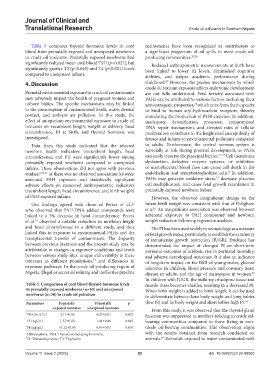
              Table 5 compares thyroid hormone levels in cord   maintenance have been recognized as contributors to
            blood from prenatally exposed and unexposed newborns   a significant proportion of oil spills in most crude oil-
            to crude oil toxicants. Prenatally exposed newborns had   producing communities. 25,26
            significantly reduced mean cord blood TSH (p<0.027), but   Reduced anthropometric measurements at birth have
            significantly greater T3 (p<0.045) and T4 (p<0.001) levels   been linked to lower IQ levels, diminished cognitive
            compared to unexposed infants.                     abilities, and subpar academic performance during
                                                                        27
            4. Discussion                                      childhood.  However, the precise mechanisms by which
                                                               crude oil toxicant exposure affects embryonic development
            Prenatal environmental exposure to crude oil contaminants   are  not  fully  understood.  Fetal  toxicity  associated  with
            may adversely impact the health of pregnant women and   PAHs can be attributed to various factors, including their
            unborn babies. The specific mechanisms may be linked   anti-estrogenic properties,  which arise from their capacity
                                                                                    28
            to the consumption of contaminated foods, water, dermal   to bind to human aryl-hydrocarbon receptors, thereby
            contact, and ambient air pollution. In this study, the   stimulating the production of P450 enzymes. In addition,
            effect of antepartum environmental exposure to crude oil   inadequate  detoxification  processes,  compromised
            toxicants on recumbent length, weight at delivery, head   DNA repair mechanisms, and elevated rates of cellular
            circumference, PI at birth, and thyroid hormone was   proliferation contribute to the heightened susceptibility of
            investigated.                                      fetuses and infants to environmental pollutants compared
              Data from this study indicated that the selected   to  adults.  Furthermore,  the  central  nervous  system  is
            newborn health indicators (recumbent length, head   especially at risk during prenatal development, as PAHs
            circumference, and PI) were significantly lower among   can easily traverse the placental barrier. 21-24  Cell membrane
            prenatally  exposed  newborns  compared  to  unexposed   dysfunction, defective enzyme systems, or inhibition
            infants. These observations did not agree with previous   of uteroplacental blood flow can cause cell  death in the
                                                                                                  6
            studies, 6,19-21  as there was no observed association between   endothelium and syncytiotrophoblast cells.  In addition,
                                                                                             19
            antenatal PAH exposure and statistically significant   PAHs may generate oxidative stress,  decrease placenta
            adverse effects on measured anthropometric indicators   cell multiplication, and cause fetal growth retardation in
            (recumbent length, head circumference, and birth weight)   prenatally exposed newborn babies.
            of PAH-exposed infants.                              However, the observed insignificant change in the

              Our findings agreed with those of Perera  et al.,    infant birth weight was consistent with that of Dehghani
                                                         22
                                                                   6
            who  observed that  PAH-DNA  adduct  compounds were   et al.  An insignificant association was observed between
            linked to a 3% decrease in head circumference. Perera   antenatal exposure to PAH compound and newborn
            et al.   observed a  notable  reduction  in  newborn  height   weight reduction following regression analysis.
                23
            and  head circumference  in  a  different  study,  and they   The PI has been used widely in neonatology as a measure
            linked this to exposure to environmental PAHs and the   of fetal growth status, particularly to establish the symmetry
            transplacental transfer of contaminants. The disparity   of intrauterine growth restriction (IUGR). Evidence has
            between previous literature and the present study may be   demonstrated  the  impact  of  changed  PI  on  short-term
            attributable to changes in exposure conditions and levels   perinatal outcomes of acidosis, rise in perinatal mortality,
            between various study sites, unique vulnerability to these   and adverse neurological outcomes. It is also an indicator
            toxicants in different populations,  and differences in   of long-term impact on the BMI of young males, glucose
                                         24
            exposure pathways. In the crude oil-producing region of   tolerance in children, blood pressure and coronary heart
            Nigeria, illegal or secret oil refining and ineffective pipeline   disease in adults, and the age of menopause in women.
                                                                                                            29
                                                               In children with IUGR, the build-up of adipose tissue and
            Table 5. Comparison of cord blood thyroid hormone levels   muscle mass becomes smaller, resulting in a decreased PI.
            in prenatally exposed newborns (n=50) and unexposed   When birth weight is added to birth length, it can be used
            newborns (n=30) to crude oil pollution             to differentiate between lean body weight and long babies

            Parameters    Prenatally      Prenatally   p       (low PI) and fat body weight and short babies high PI. 14
                        exposed neonates  unexposed neonates     From this study, it was observed that the thyroid gland
            TSH (mIU\L)    2.11±0.09      4.22±0.01   0.027    function was suppressed in mothers residing in crude oil-
            T3 (ng\dL)     1.57±0.03      1.44±0.80   0.045    bearing communities compared to those living in non-
            T4 (µg\gL)    11.22±0.05      8.05±0.07   0.001    crude oil-bearing communities. This observation aligns
            Abbreviations: TSH: Thyroid-stimulating hormone;    with the results obtained from research conducted on
                                                                      30
            T3: Triiodothyronine; T4: Thyroxine.               animals.  Zebrafish exposed to water contaminated with

            Volume 11 Issue 2 (2025)                        82                            doi: 10.36922/jctr.24.00083

