


Page 48 - MI-2-3
P. 48
Microbes & Immunity                                             Probiotics from ancient wisdom to modern days


               support in the literature, given that introducing      intervention led to a significant improvement
               a live culture to enter the bloodstream may have       in cardiac function.  The authors concluded:
                                                                                       73
               unpredictable consequences.                            “Our results suggest the cell-derived, genetically
               •   An example is found in a case report of a 25-year-  engineered EVs may be used therapeutically
                   old who was accidentally injected intravenously    for the delivery of miRNAs for the rescue of
                   with 2 billion spores of  Bacillus clausii. It took   myocardial infarction and may benefit patients in
                   5 months of various antibiotic treatments before   the future.”
                   blood tests finally confirmed clearance of the
                   infection 69                                8.5. Other delivery methods
               •   A study showed that extracellular vesicles (EVs)   •   Nasal sprays: Probiotics are being explored for
                   secreted by  B.  longum and  L. plantarum could   their potential to improve sinus health and prevent
                   be  used  for  intravenous  and  subcutaneous   respiratory infections. In a pioneering effort, one
                   administration in mice, with the subcutaneous   study developed a probiotic nasal spray that showed
                   pathway showing particular promise 70          success in treating upper respiratory issues. 74
            •   Mechanism: EVs  offer a promising avenue for   •   Inhalable probiotics: Research into the use of inhaled
                              71
               circumventing the risks associated with the direct   probiotics delivered for lung health is ongoing,
               administration of live probiotics.                 though it remains in the early stages. Nonetheless,
               •   EVs  are nanosized particles  released  by cells,   the development of a dry powder inhaler formulation
                   composed of a cellular membrane and associated   offers a promising  avenue for targeting the lower
                   proteins, enclosing an aqueous core containing   respiratory tract. 75
                   soluble  molecules,  such  as proteins  and  nucleic
                   acids.  Figure  6  is  an  artist’s  impression of  EVs   9. Challenges and considerations
                   being transferred from a donor cell to a recipient   Despite their potential benefits, the use of probiotics also
                   cell.                                       presents some challenges:
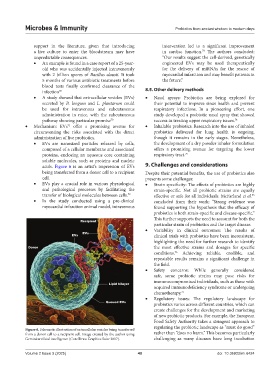
               •   EVs play a crucial role in various physiological   •   Strain specificity: The effects of probiotics are highly
                   and pathological processes by facilitating the   strain-specific. Not all probiotic strains are equally
                   transfer of biological molecules between cells. 72  effective or safe for all individuals. McFarland et al.
                                                                                                            55
               •   In the study conducted using a pre-clinical    concluded from their work: “Strong evidence was
                   myocardial infarction animal model, intravenous   found supporting the hypothesis that the efficacy of
                                                                  probiotics is both strain-specific and disease-specific.”
                                                                  This further supports the need to account for both the
                                                                  particular strain of probiotics and the target disease.
                                                               •   Variability in clinical outcomes: The results of
                                                                  clinical trials with probiotics have been inconsistent,
                                                                  highlighting the need for further research to identify
                                                                  the most effective strains and dosages for specific
                                                                  conditions.  Achieving reliable, credible, and
                                                                           76
                                                                  repeatable results remains a significant challenge in
                                                                  the field.
                                                               •   Safety concerns: While generally considered
                                                                  safe,  some  probiotic  strains  may  pose  risks  for
                                                                  immunocompromised individuals, such as those with
                                                                  acquired immunodeficiency syndrome or undergoing
                                                                  chemotherapy. 77
                                                               •   Regulatory issues: The regulatory landscape for
                                                                  probiotics varies across different countries, which can
                                                                  create challenges for the development and marketing
                                                                  of new probiotic products. For example, the European
                                                                  Food Safety Authority takes a stringent approach to
                                                                  regulating the probiotic landscape as “must do good”
            Figure 6. Schematic illustration of extracellular vesicles being transferred
            from a donor cell to a recipient cell. Image created by the author using   rather than “does no harm.” This becomes particularly
            Gemini artificial intelligence (CorelDraw Graphics Suite 2017).  challenging as many diseases have long incubation


            Volume 2 Issue 3 (2025)                         40                               doi: 10.36922/mi.6424

