


Page 76 - TD-3-4
P. 76
Tumor Discovery                                                  RNA-protein complexes deregulated in cancer


              Drugs that inhibit enzymes involved in PTMs can disrupt   delivery of synthetic sgRNAs in conjunction with the Cas9
            condensate  behavior  and influence  epitranscriptome   nuclease to target RNAs. Liu  et al. compared chemical
            modifications of RNA. These modifications include m6A,   inhibitors of methylation enzymes with CRISPRoff/on
            m6Am (dimethyladenosine), m1A, m5C, m7G, and       methylation editing systems.  CRISPRoff is a relatively
                                                                                      244
            ac4C, which are regulated by PTMs. The dependencies   recent gene editing technology based on ZNF10 KRAB,
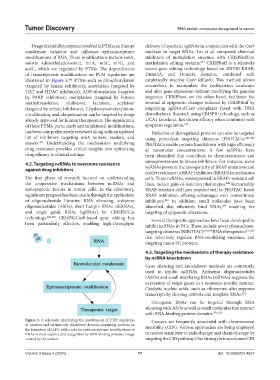
            of transcriptomic modifications on PTM regulation are   Dnmt3A, and Dnmt3L domains, combined with
            illustrated in Figure 3.  PTMs such as phosphorylation   catalytically inactive Cas9 (dCas9). This method allows
                              241
            (targeted by kinase inhibitors), acetylation (targeted by   researchers to manipulate the methylation landscape
            HAT and HDAC inhibitors), ADP-ribosylation (targeted   and alter gene expression without modifying the genome
            by  PARP inhibitors),  methylation (targeted by  histone   sequence. CRISPRon, on the other hand, facilitates the
            methyltransferase  inhibitors),  lactation,  acylation  reversal of epigenetic changes induced by CRISPRoff by
            (targeted by sirtuin inhibitors), 2-hydroxyisobutyrylation,   employing sgRNA-dCas9 complexes fused with DNA
            citrullination, and ubiquitination can be targeted by drugs   demethylases. Research using CRISPR technology, such as
            already approved for human therapeutics. The significance   UCA1 knockout, has shown efficacy when combined with
            of these PTMs, particularly epitranslational modifications,   apoptosis regulation. 245
            has been comprehensively reviewed along with an updated   Defective or dysregulated proteins can also be targeted
            list of inhibitors targeting m6A writers, readers, and   using proteolysis targeting chimeras (PROTACs). 245-247
            erasers.  Understanding the mechanisms underlying   PROTACs enable protein knockdown with high efficiency
                  241
            drug resistance provides critical insights into optimizing   at nanomolar concentrations. A  few ncRNAs have
            drug efficacy in clinical settings.                been identified that contribute to chemoresistance and
                                                               unresponsiveness to kinase inhibitors. For instance, some
            4.2. Targeting ncRNAs to overcome resistance       ncRNAs promote the oncogenicity of BRAF mutations and
            against drug inhibitors
                                                               confer resistance to BRAF inhibitors (BRAFi) in melanoma
            The first phase of research focused on understanding   cells. These ncRNAs, overexpressed in BRAFi-resistant cell
            the cooperative mechanisms between ncRNAs and      lines, induce gain-of-function phenotypes.  Remarkably,
                                                                                                 248
            antiapoptotic factors in tumor cells. In the laboratory,   BRAF-resistant cell lines respond well to PROTAC-based
            significant progress has been made through the application   BRAF inhibition, offering advantages over conventional
            of  oligonucleotide  libraries,  RNA  silencing,  antisense   inhibitors.   In  addition,  small  molecules  have  been
                                                                       249
            oligonucleotides (ASOs), short hairpin RNAs (shRNAs),   identified that efficiently bind RNAs,  enabling the
                                                                                                206
            and single  guide RNAs (sgRNAs) for  CRISPR/Cas    targeting of epigenetic alterations.
            technology. 242-245  CRISPR/Cas9-based gene editing has   Several therapeutic approaches have been developed to
            been particularly effective, enabling high-throughput
                                                               inhibit ncRNAs in BCs. These include novel ribonuclease-
                                                               targeting chimeras (RIBOTAC) 249,250  RNA therapeutics 251,252
                                                               that selectively regulate RNA-modifying enzymes, and
                                                               targeting major SG proteins.
                                                               4.3. Targeting the mechanisms of therapy resistance
                                                               by ncRNA knockdown
                                                               Gene silencing and knockdown methods are commonly
                                                               used to inhibit ncRNAs. Antisense oligonucleotides
                                                               (ASOs) and small interfering RNAs (siRNAs) suppress the
                                                               expression of target genes in a sequence-specific manner.
                                                               Catalytic nucleic acids, such as ribozymes, also suppress
                                                               transcripts by cleaving mRNAs and template RNAs. 251

                                                                 Oncogenic RNAs can be targeted through RNA
                                                               silencing with ASOs as well as small molecules that interact
                                                               with RNA-binding protein domains. 252-255
            Figure 3. A schematic  illustrating  the  involvement  of  PTM  regulation   Cancers are frequently associated with chromosomal
            of proteins and intrinsically disordered domain-containing proteins in   instability (CIN). Various approaches are being employed
            the formation of LLPS, with a role for epitranscriptome modifications of
            RNAs in their stability and recognition by RNA-binding proteins. Image   to restore sensitivity to radiotherapy and chemotherapy by
            created by the authors                             targeting the CIN pathway. One strategy is to accelerate CIN


            Volume 3 Issue 4 (2024)                         17                                doi: 10.36922/td.4657

