


Page 84 - AC-3-2
P. 84
Arts & Communication                                                             Self-portraits as masks


            references to the work of sociologist Erving Goffman. It
            also presents the works in chronological order to highlight
            the different modes of self-representation adopted by the
            artist  over  time.  Despite the aforementioned initiatives,
                         9
            there is still no theoretical production that thoroughly
            addresses the significance of the mask in Wearing’s work,
            placing  it  in the postmodern  context.  In general,  there
            is a paucity of scholarly publications on the work of this
            artist although she has received significant recognition,
            including winning the 1997 Turner Prize, and exhibited
            works in major museums and institutions. Therefore, this
            article aims to contribute to the existing body of knowledge
            by identifying theoretical frameworks that can provide
            new insights into the study of the self-portrait in Wearing’s
            work as well as that of other contemporary artists.

            2. The face as a mask, the mask as a face
            The mask plays a central role in Wearing’s practice,
            particularly in her works from the early 2000s, such as
            the  Family Album  photographic  series  (2003  –  2006).
            Wearing presents herself with the features of her relatives
            by reproducing images from her family album. The artist,
            thus, explores the ambiguity of self-perception and the
            perception of others by taking on the faces, bodies, and
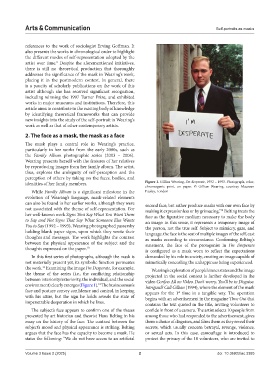
            identities of her family members.                  Figure 1. Gillian Wearing, I’m desperate, 1992 – 1993. Photograph, color,
                                                               chromogenic  print, on  paper.  © Gillian Wearing, courtesy Maureen
              While Family Album is a significant milestone in the   Pauley, London
            evolution of Wearing’s language, mask-related elements
            can also be found in her earlier works, although they were   second face, but rather produce masks with our own face by
            not associated with the theme of self-representation. For   making it expressionless or by grimacing.”  Belting treats the
                                                                                               13
            her well-known work Signs That Say What You Want Them   face as the figurative medium necessary to make the body
            to Say and Not Signs That Say What Someone Else Wants   an image: in this sense, it represents a temporary image of
            You to Say (1992 – 1993), Wearing photographed passersby   the person, not the true self. Subject to mimicry, gaze, and
            holding blank paper signs, upon which they wrote their   language, the face is the seat of multiple images of the self, cast
            thoughts and messages. The work highlights the contrast   as  masks according to circumstance.  Confirming  Belting’s
            between the physical appearance of the subject and the   statement, the face of the protagonist in  I’m Desperate
            thoughts expressed on the paper. 10                is  configured  as  a  mask  worn  to  reflect  the  expectations
              In this first series of photographs, although the mask is   demanded by his role in society, creating an image capable of
            not materially present yet, its symbolic function permeates   mimetically concealing the unhappiness being experienced.
            the work.  Examining the image I’m Desperate, for example,   Wearing’s exploration of people’s inner states and the image
                   11
            the theme of the series (i.e., the conflicting relationship   projected in the social context is further developed in the
            between interiority/exteriority, the individual, and the social   video Confess All on Video. Don’t worry, You’ll be in Disguise.
            environment) clearly emerges (Figure 1).  The businessman’s   Intrigued? Call Gillian (1994), where the element of the mask
                                           12
            face and posture convey confidence and control, in keeping   appears for the 1   time in a tangible way. The operation
                                                                             st
            with his attire, but the sign he holds reveals the state of   begins with an advertisement in the magazine Time Out that
            impenetrable desperation in which he lives.        contains the text quoted in the title, inviting volunteers to
              The subject’s face appears to confirm one of the theses   confide in front of a camera. The artist selects 10 people from
            presented by art historian and theorist Hans Belting in his   among those who had responded to the advertisement, gives
            essay on the history of the face. The contrast between the   them a choice of disguises, and films them as they reveal their
            subject’s mood and physical appearance is striking. Belting   secrets, which usually concern betrayal, revenge, violence,
            argues that the face has the capacity to become a mask. He   or sexual acts. In this case, camouflage is introduced to
            states the following: “We do not have access to an artificial   protect the privacy of the 10 volunteers, who are invited to


            Volume 3 Issue 2 (2025) olume 3 Issue 2 (2025)
                                                                                             doi: 10.36922/ac.338510.36922/ac.3385
            V                                               2  2                             doi:

