


Page 69 - AIH-1-1
P. 69
Artificial Intelligence in Health                                       Advancing fetal health classification


               with positive labels, affirming its ability to minimize   correlation between predicted and true labels,
               false positives and enhance overall classification   reinforcing the model’s efficacy in the nuanced task of
               accuracy.                                          fetal health classification. The comprehensive suite of
            •   The F1 score, harmonizing precision and recall, was   evaluation metrics collectively attests to the LightGBM
               found to be 0.9863. This balanced metric provides a   model’s exceptional performance and reliability in
               comprehensive evaluation of the model’s performance,   discerning fetal health conditions.
               accounting for both false positives and false negatives.   Overall, the results demonstrate the effectiveness of
               The high F1 score signifies that the model has achieved   the LightGBM model in accurately classifying fetal health
               a favorable equilibrium between precision and recall,   conditions. The high accuracy, AUC, recall, precision, F1
               indicative of its effectiveness in balancing the trade-off   score, kappa, and MCC scores indicate that the model has
               between type I and type II errors.              the potential to assist medical professionals in assessing
            •   The kappa coefficient, a measure of agreement between   fetal  health  and  identifying  potential  abnormalities.
               predicted and actual labels, yielded a substantial score   The performance metrics validate the robustness and
               of 0.9748. This result underscores a notable level of   reliability of our proposed model, reinforcing its potential
               agreement beyond what could be expected by chance   as a valuable tool in the field of obstetrics and fetal health
               alone, accentuating the reliability and consistency of   management.
               the model’s predictions.
            •   Finally, the MCC obtained a noteworthy score     In addition to the above, we would like to highlight the
               of 0.9749. Particularly valuable in the context of   following findings:
               imbalanced datasets, the MCC accounts for true   •   The LightGBM model was able to achieve high
               positives, true negatives, false positives, and false   accuracy even when trained on a relatively small
               negatives. The high MCC value signifies a robust   dataset. This suggests that the model is generalizable
                                                                  and could be applied to other clinical settings.
                                                               •   The model was able to accurately classify fetal health
                                                                  conditions across a wide range of gestational ages.
                                                                  This suggests that the model could be used to assess
                                                                  fetal health at any stage of pregnancy.
                                                               •   The model was able to identify potential abnormalities
                                                                  with high sensitivity and specificity. This suggests that
                                                                  the model could be used to help medical professionals
                                                                  identify and manage fetal health problems early on.
                                                               •   The  receiver  operating  characteristic  (ROC)  curve,
                                                                  which delineates the trade-off between sensitivity
                                                                  and specificity in a classification model, serves as a
                                                                  graphical representation of the model’s performance
                                                                  across various threshold values. This curve for the
                                                                  LGBMClassifier is shown in Figure 3.
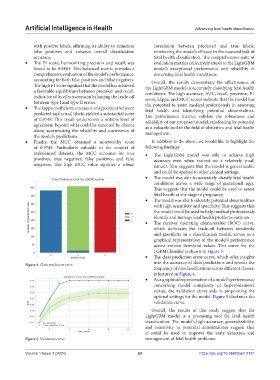
                                                               •   The class prediction error curve, which offer insights
                                                                  into the accuracy of class predictions and reveals the
            Figure 4. Class prediction error.
                                                                  frequency of misclassifications across different classes,
                                                                  is featured in Figure 4.
                                                               •   As a graphical representation of a model’s performance
                                                                  concerning model complexity or hyperparameter
                                                                  values, the validation curve aids in pinpointing the
                                                                  optimal settings for the model. Figure 5 illustrates the
                                                                  validation curve.
                                                                 Overall, the results of this study suggest that the
                                                               LightGBM model is a promising tool for fetal health
                                                               classification. The model’s high accuracy, generalizability,
                                                               and sensitivity to potential abnormalities suggest that
                                                               it could be used to improve the early detection and
            Figure 5. Validation curve.                        management of fetal health problems.


            Volume 1 Issue 1 (2024)                         63                        https://doi.org/10.36922/aih.2121

