


Page 118 - AIH-1-2
P. 118
Artificial Intelligence in Health                                Medical instruction-tuning for Japanese LLMs


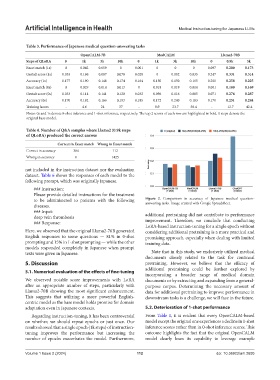
            Table 3. Performance of Japanese medical question‑answering tasks
                                   OpenCALM‑7B                      MedCALM                    Llama2‑70B
            Steps of QLoRA   0      1k      3k     10k      0      1k      3k     10k      0     0.9k     3k
            Exact match (1s)  0    0.042   0.059    0     0.001     0      0       0     0.097   0.200   0.173
            Gestalt score (1s)  0.053  0.186  0.087  0.078  0.028   0     0.002   0.035  0.247   0.331   0.314
            Accuracy (1s)  0.177   0.190   0.148   0.174  0.164   0.150   0.150   0.165  0.200   0.258   0.225
            Exact match (0s)  0    0.029   0.014   0.013    0     0.018   0.019   0.014  0.001   0.180   0.169
            Gestalt score (0s)  0.033  0.114  0.141  0.120  0.032  0.096  0.116   0.085  0.071   0.276   0.287
            Accuracy (0s)  0.170   0.182   0.166   0.193  0.185   0.172   0.240   0.183  0.170   0.251   0.244
            Training hours   -      4.6     24      37      -      8.9    23.7    58.4     -      12.7    42.4
            Notes: 0s and 1s denote 0-shot inference and 1-shot inference, respectively. The top 2 scores of each row are highlighted in bold. 0 steps denote the
            original base model.

            Table 4. Number of Q&A samples where Llama2 (0.9k steps
            of QLoRA) produced the correct answer

                          Correct in Exact match Wrong in Exact match
            Correct in accuracy  384             112
            Wrong in accuracy    0              1425

            not included in the instruction dataset nor the evaluation
            dataset. Table 6 shows the responses of each model to the
            following prompt, which was originally Japanese.
               ### Instruction:
               Please provide detailed instructions for the treatment
               to be administered to patients with the following   Figure  2. Comparison in accuracy of Japanese medical question-
                                                               answering tasks. Image created with Google Spreadsheet.
               diseases.
               ### Input:                                      additional pretraining did not contribute to performance
               deep vein thrombosis
               ### Response:                                   improvement. Therefore, we conclude that conducting
                                                               LoRA-based instruction-tuning for a single epoch without
            Here, we observed that the original Llama2-70B generated   considering additional pretraining is a more practical and
            English responses to some questions — 81% in 0-shot   promising approach, especially when dealing with limited
            prompting and 15% in 1-shot prompting — while the other   training data.
            models  responded completely in  Japanese  when  prompt
            texts were given in Japanese.                        Note that in this study, we exclusively utilized medical
                                                               documents  closely  related  to  the  task  for  continual
            5. Discussion                                      pretraining.  However,  we  believe  that  the  efficacy  of
                                                               additional pretraining could be further explored by
            5.1. Numerical evaluation of the effects of fine-tuning
                                                               incorporating a broader range of medical domain
            We  observed  notable  score improvements  with  LoRA   documents or by extracting and expanding from a general-
            after an appropriate number of steps, particularly with   purpose corpus. Determining the necessary amount of
            Llama2-70B showing the most significant enhancement.   data for additional pretraining to improve performance in
            This suggests that utilizing a more powerful English-  downstream tasks is a challenge, we will face in the future.
            centric model as the base model holds promise for domain
            adaptation even in Japanese contexts.              5.2. Deterioration of 1-shot performance
              Regarding instruction-tuning, it has been controversial   From  Table 1, it is evident that every OpenCALM-based
            on whether, we should repeat epochs or just once. Our   model except the original one experiences a decline in 1-shot
            results showed that a single epoch (1k steps) of instruction-  inference scores rather than in 0-shot inference scores. This
            tuning improves the performance but increasing the   outcome highlights the fact that the original OpenCALM
            number of epochs exacerbates the model. Furthermore,   model clearly loses its capability to leverage example


            Volume 1 Issue 2 (2024)                        112                               doi: 10.36922/aih.2695

