


Page 10 - AIH-1-3
P. 10
Artificial Intelligence in Health                                    AI in pharma: Embracing transformation


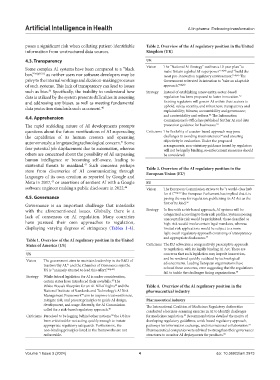
            poses a significant risk when collating patient-identifiable   Table 2. Overview of the AI regulatory position in the United
            information from unstructured data sources.        Kingdom (UK)
            4.3. Transparency                                  UK

            Some complex AI systems have been compared to a “black   Vision  The “National AI Strategy” outlines a 10-year plan “to
                                                                       make Britain a global AI superpower”
                                                                                                  and “build the
                                                                                               51(p4)
            box,” 39(p3511)  as neither users nor software developers may be   most pro-innovation regulatory environment.” 51(p5)  The
            privy to the internal workings and decision-making processes   Government reiterated its intention to “take an adaptable
            of such systems. This lack of transparency can lead to issues   approach.” 52(p6)
            such as bias.  Specifically, the inability to understand how   Strategy  Instead of establishing a new entity, sector-based
                      36
            data is utilized by the system presents difficulties in assessing   regulation has been proposed to foster innovation.
                                                                                                       52
            and addressing any biases, as well as meeting fundamental   Existing regulators will govern AI within their sectors to
            data protection standards such as consent. 40              uphold: safety, security, and robustness; transparency and
                                                                       explainability; fairness; accountability and governance;
                                                                                          52
            4.4. Apprehension                                          and contestability and redress.  The Information
                                                                       Commissioner’s Office has published further AI and data
            The rapid unfolding nature of AI developments prompts      protection guidance for businesses. 53
            questions about the future ramifications of AI superseding   Criticisms The flexibility of a sector-based approach may pose
            the capabilities of its human creators and operating       challenges in avoiding inconsistencies  and ensuring
                                                                                               54
            autonomously; a longstanding technological concern.  Some   objectivity in evaluation. Under the proposed
                                                    41
                                                                       arrangements, non-statutory guidance issued by regulators
            fear potential job displacement due to automation, whereas   will not be legally binding, so enforcement measures should
            others are concerned about the possibility of AI surpassing   be considered.
            human intelligence or becoming self-aware, leading to
            existential threats to mankind.  Such concerns perhaps   Table 3. Overview of the AI regulatory position in the
                                     42
            stem from discoveries of AI communicating through   European Union (EU)
            languages of its own creation as reported by Google and
            Meta in 2017,  or assertions of sentient AI with a Google   EU
                       43
            software engineer making a public disclosure in 2022. 44  Vision  The European Commission strives to be “a world-class hub
                                                                       for AI.” 55(p1)  The European Parliament has implied that it is
            4.5. Governance                                            paving the way for regulation, publicizing its AI Act as the
            Governance  is an  important challenge that interlinks     first of its kind. 56
            with the aforementioned issues. Globally, there is a   Strategy  In line with a risk-based approach, AI systems will be
            lack of consensus on AI regulation. Many countries         categorized according to their risk profiles. Systems posing
                                                                       unacceptable risk would be prohibited, those classified as
            have pursued their own approaches to regulation,           high-risk would invoke certain legal mandates, whereas
            displaying  varying  degrees  of stringency  (Tables  1-4).   limited risk applications would be subject to a more
                                                                       light-touch regulatory approach consisting of transparency
            Table 1. Overview of the AI regulatory position in the United   and appropriate disclosures. 57
            States of America (US)                             Criticisms The EU advocates a comparatively prescriptive approach
                                                                       to regulation, with its legally binding AI Act. There are
            US                                                         concerns that such legislation may impede innovation,
                                                                       and be rendered quickly outdated by technological
            Vision  The government aims to maintain leadership in the R&D of   advancements. Leading European organizations have
                              45
                    trustworthy AI,  and the Chamber of Commerce says the   echoed these concerns, even suggesting that the regulations
                    US is “uniquely situated to lead this effort.” 46(p10)
                                                                       fail to tackle the challenges facing organizations. 58
            Strategy  While federal legislation for AI is under consideration,
                    certain states have introduced their own bills.  The
                                                 47
                    White House’s Blueprint for an AI Bill of Rights  and the   Table 4.  Overview of the AI regulatory position in the
                                                  48
                    National Institute of Standards and Technology’s AI Risk   pharmaceutical industry
                    Management Framework  aim to improve trustworthiness,
                                    49
                    mitigate risk, and present principles to guide AI design,   Pharmaceutical industry
                    development, and usage. Recently, the AI Commission   The International Coalition of Medicines Regulatory Authorities
                    called for a risk-based regulatory approach. 46  conducted a horizon-scanning exercise in AI to identify challenges
            Criticisms Perceived to be lagging behind other nations,  the US has   for medicines regulation.  Recommendations detailed the merits of
                                                50
                                                                               59
                    been criticized for not acting quickly enough to instate   developing regulatory guidelines, a risk-based regulatory approach,
                    appropriate regulatory safeguards. Furthermore, the   pathways for information exchange, and international collaboration.
                                                                                                           59
                    non-binding principles listed in the frameworks are not   Pharmaceutical companies were advised to strengthen their governance
                    enforceable.                               structures to monitor AI deployments for products. 59
            Volume 1 Issue 3 (2024)                         4                                doi: 10.36922/aih.2973

