


Page 12 - AIH-1-3
P. 12
Artificial Intelligence in Health                                    AI in pharma: Embracing transformation


                                                               6.3. Advanced technology at hand

                                                               Experts anticipate that human-level AI will be achievable
                                                                                        74
                          Research &   • Predictive modelling  before the turn of the century.  Without maintaining a
                          Discovery    • Drug repurposing
                                                               forward-looking perspective when evaluating investment
                                                               opportunities for innovative ideas, pharmaceutical
                                                               businesses risk losing their market position to future
                                                               visionaries who may disrupt the industry.
                     Clinical
                      Trials     • Patient recruitment         7. Conclusion
                                 • Adverse event prediction
                                                               In the quest to advance science and improve public health,
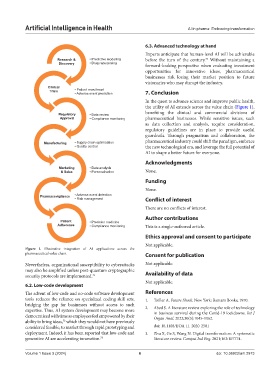
                                                               the utility of AI extends across the value chain (Figure 1),
                          Regulatory   • Data review           benefiting the clinical and commercial divisions of
                           Approval    • Compliance monitoring  pharmaceutical businesses. While sensitive issues, such
                                                               as data collection and analysis, require consideration,
                                                               regulatory guidelines are in place to provide useful
                                                               guardrails. Through pragmatism and collaboration, the
                    Manufacturing  • Supply chain optimisation  pharmaceutical industry could shift the paradigm, embrace
                                 • Quality control             the new technological era, and leverage the full potential of
                                                               AI to shape a better future for everyone.
                                                               Acknowledgments
                          Marketing    • Data analysis
                           & Sales     • Personalisation       None.
                                                               Funding

                                                               None.
                  Pharmacovigilance  • Adverse event detection
                                 • Risk management             Conflict of interest
                                                               There are no conflicts of interest.

                                                               Author contributions
                           Patient     • Precision medicine
                          Adherence    • Compliance monitoring  This is a single-authored article.

                                                               Ethics approval and consent to participate
                                                               Not applicable.
            Figure  1. Illustrative integration of AI applications across the
            pharmaceutical value chain.                        Consent for publication

            Nevertheless, organizational susceptibility to cyberattacks   Not applicable.
            may also be amplified unless post-quantum cryptographic
            security protocols are implemented. 71             Availability of data
                                                               Not applicable.
            6.2. Low-code development
            The advent of low-code and no-code software development   References
            tools  reduces  the  reliance on specialized  coding  skill sets,   1.   Toffler A. Future Shock. New York: Bantam Books; 1970.
            bridging the gap for businesses without access to such   2.   Abed S. A literature review exploring the role of technology
            expertise. Thus, AI system development may become more   in business survival during the Covid-19 lockdowns. Int J
            democratized with time as employees feel empowered by their   Organ Anal. 2022;30(5):1045-1062.
            ability to bring ideas,  which they would not have previously
                            72
            considered feasible, to market through rapid prototyping and      doi: 10.1108/IJOA-11-2020-2501
            deployment. Indeed, it has been reported that low-code and   3.   Zhu X, Ge S, Wang N. Digital transformation: A systematic
            generative AI are accelerating innovation. 73         literature review. Comput Ind Eng. 2021;162:107774.


            Volume 1 Issue 3 (2024)                         6                                doi: 10.36922/aih.2973

