


Page 98 - AIH-1-4
P. 98
Artificial Intelligence in Health                               Transformer-based radiology report summaries


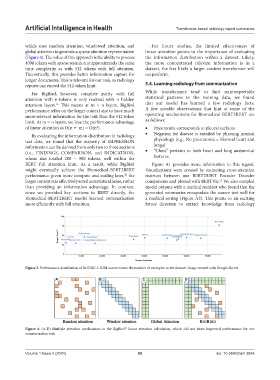
            which uses random attention, windowed attention, and   For future studies, the limited effectiveness of
            global attention to generate a sparse attention representation   linear attention points to the importance of evaluating
            (Figure 4). The value of this approach is the ability to process   the  information  distribution  within  a dataset. Likely,
            4096 tokens with sparse attention at approximately the same   the more concentrated relevant information is in a
            time complexity as with 512 tokens with full attention.   dataset, the less likely a larger context transformer will
            Theoretically, this provides better information capture for   outperform.
            longer documents. This is relevant for our task, as radiology
            reports can exceed the 512-token limit.            5.4. Learning radiology from summarization
              For BigBird, however, complete parity with full   While transformers tend to find uninterpretable
            attention with n-tokens is only realized with n hidden   statistical patterns in the training data, we found
                         16
            attention layers.  This means at m < n layers, BigBird   that our model has learned a few radiology facts.
            performance relies on the larger context size to have much   A  few notable observations that hint at some of the
            more relevant information for the task than the 512 token   operating mechanisms for Biomedical-BERT2BERT are
            limit. At m = n layers, we lose the performance advantage   as follows:
            of linear attention as O(n ⇤ m) = O(n ).           •   Pneumonia corresponds to pleural surfaces
                                          2
              By evaluating the information distribution in radiology   •   Negation for disease is entailed by phrasing normal
            text data, we found that the majority of IMPRESSION   physiology (e.g., No pneumonia = Normal heart and
            information can be derived from only two to three sections   lungs)
            (i.e.,  FINDINGS, COMPARISON,  and  INDICATION),   •   “Chest” pertains to both heart and lung anatomical
            whose size totaled 200 – 300 tokens, well within the   features.
            BERT full attention limit. As a result, while BigBird   Figure A1 provides more information in this regard.
            might eventually achieve the  Biomedical-BERT2BERT   Visualizations were created by extracting cross-attention
            performance given more compute and scaling laws,  the   matrices between our BERT2BERT Encoder Decoder
                                                      20
            larger context size effectively acted as statistical noise, rather   components and plotted with BERTViz.  We also sampled
                                                                                              21
            than providing an information advantage. In contrast,   model outputs with a medical resident who found that the
            since we provided key sections to BERT directly, the   generated summaries encapsulate the source text well for
            Biomedical-BERT2BERT  model  learned  summarization   a medical setting (Figure A2). This points to an exciting
            more efficiently with full attention.              future direction to extract knowledge from radiology


            Figure 3. Performance distribution of ROUGE-L SUM scores versus the number of examples in the dataset. Image created with Google Sheets


                         A                 B                  C                 D


            Figure  4. (A-D) Multiple attention mechanisms in the BigBird  linear attention calculation, which did not show improved performance for our
                                                      16
            summarization task


            Volume 1 Issue 4 (2024)                         92                               doi: 10.36922/aih.3846

