


Page 129 - AIH-2-2
P. 129
Artificial Intelligence in Health                                               Transgender healthcare


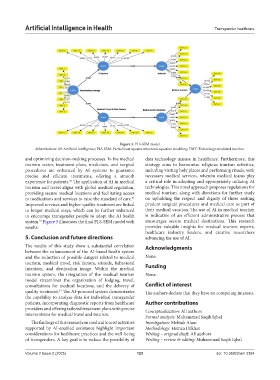
                                                    Figure 3. PLS-SEM model
                Abbreviations: AI: Artificial intelligence; PLS-SEM: Partial least squares structural equation modeling; TMT: Technology-mediated tourism.
            and optimizing decision-making processes. In the medical   data  technology  misuse  in  healthcare.  Furthermore, this
            tourism sector, treatment plans, medicines, and surgical   strategy aims to harmonize religious tourism activities,
            procedures  are  enhanced  by  AI  systems  to  guarantee   including visiting holy places and performing rituals, with
            precise and efficient treatments, offering a smooth   necessary medical services, wherein medical teams play
                               50
            experience for patients.  The application of AI in medical   a critical role in adopting and appropriately utilizing AI
            tourism and travel aligns with global medical regulation,   technologies. This novel approach proposes regulations for
            providing secure medical locations and facilitating access   medical tourism, along with directions for further study
            to medications and services to raise the standard of care.    on upholding the respect and dignity of those seeking
                                                         51
            Improved services and higher-quality treatment are linked   prudent surgical procedures and medical care as part of
            to longer medical stays, which can be further enhanced   their medical vacation. The use of AI in medical tourism
            to encourage transgender people to adopt the AI health   is indicative of an efficient administrative process that
            system.  Figure 3 illustrates the final PLS-SEM model with   encourages secure medical destinations. This research
                  52
            results.                                           provides  valuable  insights  for medical tourism  experts,
                                                               healthcare  industry  leaders,  and  creative  researchers
            5. Conclusion and future directions                advancing the use of AI.
            The results of this study show a substantial correlation   Acknowledgments
            between the enhancement of the AI-based health system
            and the reduction of possible dangers related to medical   None.
            tourism, medical travel, risk factors, attitude, behavioral
            intention, and destination image. Within the medical   Funding
            tourism system, the integration of the medical tourism   None.
            model streamlines the organization of lodging, travel,
            consultations for medical locations, and the delivery of   Conflict of interest
            quality treatment.  The AI-powered system demonstrates   The authors declare that they have no competing interests.
                          53
            the capability to analyze data for individual transgender
            patients, incorporating diagnostic reports from healthcare   Author contributions
            providers and offering tailored treatment plans with precise   Conceptualization: All authors
            interventions for medical travel and tourism.
                                                               Formal analysis: Muhammad Saqib Iqbal
              The findings of this research on medical tourist activities   Investigation: Mehtab Alam
            supported by AI-enabled assistance highlight important   Methodology: Hamza Iftikhar
            considerations for healthcare practices and the well-being   Writing – original draft: All authors
            of transgenders. A key goal is to reduce the possibility of   Writing – review & editing: Muhammad Saqib Iqbal


            Volume 2 Issue 2 (2025)                        123                               doi: 10.36922/aih.3384

