


Page 126 - AIH-2-2
P. 126
Artificial Intelligence in Health                                               Transgender healthcare


            to the place of choice. One key aspect is the measurement   and the specific use of healthcare options provided through
            of AI in the context of medical tourism, which is based   medical tourism. 42
                                                    38
            on the advantages and image of the destination.  Travel
            restrictions, both inherent and interactive, are addressed   3.2. Study population and sampling
            to meet the needs of transgender travelers while reducing   A quantitative research technique was used to investigate
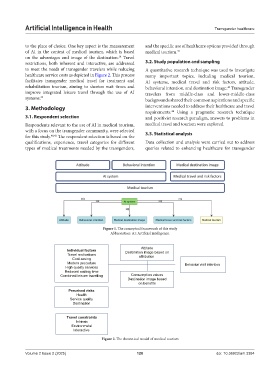
            healthcare service costs as depicted in Figure 2. This process   many important topics, including medical tourism,
            facilitates transgender  medical travel for treatment and   AI systems, medical travel and risk factors, attitude,
            rehabilitation  tourism,  aiming  to  shorten  wait  times  and   behavioral intention, and destination image.  Transgender
                                                                                                  43
            improve integrated leisure travel through the use of AI   travelers from middle-class  and  lower-middle-class
            systems. 39                                        backgrounds shared their common aspirations and specific

            3. Methodology                                     interventions needed to address their healthcare and travel
                                                               requirements.  Using a pragmatic research technique
                                                                          44
            3.1. Respondent selection                          and positivist research paradigm, answers to problems in
            Respondents relevant to the use of AI in medical tourism,   medical travel and tourism were explored.
            with a focus on the transgender community, were selected
            for this study. 40,41  The respondent selection is based on the   3.3. Statistical analysis
            qualifications, experience, travel categories for different   Data collection and analysis were carried out to address
            types of medical treatments needed by the transgenders,   queries related to enhancing healthcare for transgender


                                             Figure 1. The conceptual framework of this study
                                                Abbreviation: AI: Artificial intelligence.


                                                             Attitude
                              Individual factors      Destination image based on
                              Travel motivations            attribution
                                Cost-saving
                              Modern procedure                                  Behavior visit intention
                             High-quality services
                             Reduced waiting time
                           Combined leisure travelling   Consumption values
                                                       Destination image based
                                                            on benefits
                              Perceived risks
                                  Health
                               Service quality
                                Destination


                             Travel constraints
                                 Intrinsic
                               Environmetal
                                Interactive
                                            Figure 2. The theoretical model of medical tourism


            Volume 2 Issue 2 (2025)                        120                               doi: 10.36922/aih.3384

