


Page 57 - AIH-2-2
P. 57
Artificial Intelligence in Health                            Predicting ICU mortality: A stacked ensemble model


            meta-model (Level-1), by combining the aforementioned   only hyperparameter variation was that the first CatBoost
            predictions and  effectively learning  to weight  the   model had a depth of 8, whereas the second had a depth
            predictions of each Level-0 model. Taken together, the   of 7. Moreover, the importance of the second CatBoost
            stacked ensemble learning outputs the final predictions   model was equal to 1. Guided by the feature importance
            and delivers more accurate and robust results.     analysis of the respective classifier, the second CatBoost
                                                               model reduced its training feature vector by excluding
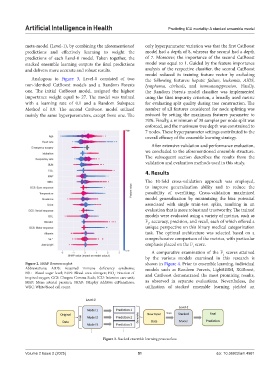
              Analogous to  Figure  3, Level-0 consisted of two   the following features:  hepatic failure,  leukemia,  AIDS,
            non-identical CatBoost models and a Random Forests   lymphoma,  cirrhosis, and  immunosuppression. Finally,
            one. The initial CatBoost model, assigned the highest   the Random Forests model classifier was implemented
            importance  weight  equal  to  27. The  model was  trained   using the Gini impurity criterion, a broadly used metric
            with a learning rate of 0.1 and a Random Subspace   for evaluating split quality during tree construction. The
            Method of 0.9. The second CatBoost model utilized   number of all features considered for node splitting was
            mainly the same hyperparameters, except from one. The   reduced by setting the maximum features parameter to
                                                               70%. Finally, a minimum of 30 samples per node split was
                                                               enforced, and the maximum tree depth was constrained to
                                                               7 nodes. These hyperparameter settings contributed to the
                                                               overall efficacy of the ensemble learning strategy.
                                                                 After extensive validation and performance evaluation,
                                                               we concluded to the aforementioned ensemble structure.
                                                               The subsequent section describes the results from the
                                                               validation and evaluation methods used in this study.

                                                               4. Results
                                                               The  10-fold  cross-validation  approach  was  employed,
                                                               to improve generalization ability and to reduce the
                                                               possibility of overfitting. Cross-validation maximized
                                                               model generalization by minimizing the bias potential
                                                               associated with single train-test splits, resulting in an
                                                               evaluation that is more robust and trustworthy. The trained
                                                               models were evaluated using a variety of metrics, such as
                                                               F , accuracy, precision, and recall, each of which offered a
                                                                1
                                                               unique perspective on this binary medical categorization
                                                               task. The optimal architecture was selected based on a
                                                               comprehensive comparison of the metrics, with particular
                                                               emphasis placed on the F  score.
                                                                                   1
                                                                 A comparative examination of the F  scores attained
                                                                                                1
                                                               by  the  various  models  examined  in  this  research  is
            Figure 2. SHAP Beeswarm plot                       shown in Figure 4. Prior to ensemble learning, individual
            Abbreviations: AIDS: Acquired immune deficiency syndrome;   models such as Random  Forests, LightGBM, XGBoost,
            BSL:   Blood sugar level; BUN: Blood urea nitrogen; FiO : Fraction of   and CatBoost demonstrated the most promising results,
                                                  2
            inspired oxygen; GCS: Glasgow Comma Scale; ICU: Intensive care unit;
            MAP: Mean arterial pressure; SHAP: SHapley Additive exPlanations;   as observed in separate evaluations. Nevertheless, the
            WBC: White blood cell count.                       utilization of stacked ensemble learning yielded an


                                             Figure 3. Stacked ensemble learning process flow


            Volume 2 Issue 2 (2025)                         51                               doi: 10.36922/aih.4981

