


Page 102 - AIH-2-4
P. 102
Artificial Intelligence in Health                                    AI vs humans in clinical code conversion


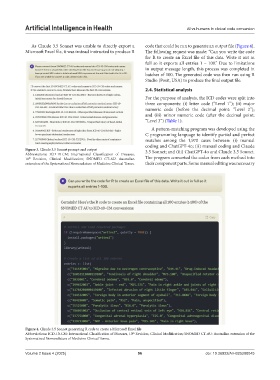
              As Claude 3.5 Sonnet was unable to directly export a   code that could be run to generate an output file (Figure 4).
            Microsoft Excel file, it was instead instructed to produce R   The following request was made: “Can you write the code
                                                               for R to create an Excel file of this data. Write it out in
                                                               full so it exports all entries 1 – 100.” Due to limitations
                                                               in output message length, this process was completed in
                                                               batches of 100. The generated code was then run using R
                                                               Studio (Posit, USA) to produce the final output file.

                                                               2.4. Statistical analysis
                                                               For the purpose of analysis, the ICD codes were split into
                                                               three  components:  (i)  letter  code  (“Level  1”);  (ii) major
                                                               numeric code (before the decimal point: “Level 2”);
                                                               and (iii) minor numeric code (after the decimal point:
                                                               “Level 3”) (Table 1).
                                                                 A pattern-matching program was developed using the
                                                               C programming language to identify partial and perfect
                                                               matches among the 1,970  cases between: (i)  manual
                                                               coding and ChatGPT-4o; (ii) manual coding and Claude
            Figure 3. Claude 3.5 Sonnet prompt and output      3.5 Sonnet; and (iii) ChatGPT-4o and Claude 3.5 Sonnet.
            Abbreviations: ICD-10-CM: International Classification of Diseases,
            10   Revision,  Clinical  Modification;  SNOMED  CT-AU:  Australian   The program converted the codes from each method into
             th
            extension of the Systematized Nomenclature of Medicine Clinical Terms.  their component parts. Some manual editing was necessary


            Figure 4. Claude 3.5 Sonnet generating R code to create a Microsoft Excel file
            Abbreviations: ICD-10-CM: International Classification of Diseases, 10  Revision, Clinical Modification; SNOMED CT-AU: Australian extension of the
                                                         th
            Systematized Nomenclature of Medicine Clinical Terms.

            Volume 2 Issue 4 (2025)                         96                          doi: 10.36922/AIH025200045

