


Page 8 - AJWEP-22-5
P. 8
Rajak, et al.

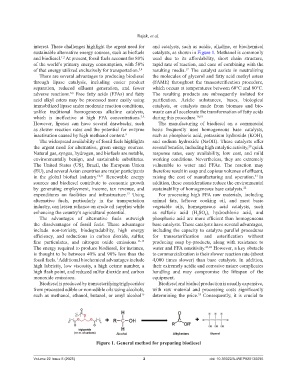
                interest. These challenges highlight the urgent need for   and catalysts, such as acidic, alkaline, or biochemical
                sustainable alternative energy sources, such as biofuels   catalysts, as shown in Figure 1. Methanol is commonly
                and biodiesel.  At present, fossil fuels account for 80%   used  due  to  its  affordability,  short  chain  structure,
                            1,2
                of the world’s primary energy consumption, with 58%   rapid rate of reaction, and ease of combining with the
                of that energy utilized exclusively for transportation. 3,4  resulting media.   The catalyst  assists in neutralizing
                                                                                   17
                  There are several advantages to producing biodiesel   the molecules of glycerol and fatty acid methyl esters
                through lipase catalysis,  including  easier product   (FAME)  throughout  the  transesterification  procedure,
                separation,  reduced  effluent  generation,  and  fewer   which occurs at temperatures between 60°C and 80°C.
                adverse reactions.  Free fatty acids (FFAs) and fatty   The resulting products are subsequently isolated for
                                5,6
                acid alkyl esters may be processed more easily using   purification.  Acidic  substances,  bases,  biological
                immobilized lipase under moderate reaction conditions,   catalysts,  or catalysts  made from biomass and bio-
                unlike traditional  homogeneous alkaline  catalysis,   waste can all accelerate the transformation of fatty acids
                which  is  ineffective  at  high  FFA  concentrations. 7,8   during this procedure. 18,19
                However, lipases can have several drawbacks, such      The manufacturing of biodiesel on a commercial
                as slower reaction rates and the potential for enzyme   basis frequently uses homogeneous base catalysts,
                inactivation caused by high methanol content. 9     such as phosphoric acid, potassium hydroxide (KOH),
                  The widespread availability of fossil fuels highlights   and  sodium  hydroxide  (NaOH).  These  catalysts  offer
                the urgent need for alternative, green energy sources.   several benefits, including high catalytic activity,  quick
                                                                                                              20
                Natural gas, syngas, hydrogen, and biofuels are notable,   response rates,  easy availability, low cost, and mild
                environmentally  benign, and sustainable substitutes.   working conditions. Nevertheless, they are extremely
                The  United  States  (US),  Brazil,  the  European  Union   vulnerable  to  water  and  FFAs.  The  reaction  may
                (EU), and several Asian countries are major participants   therefore result in soap and copious volumes of effluent,
                in the global biofuel industry. 10,11  Renewable energy   raising  the  cost of manufacturing  and operation. In
                                                                                                                 21
                sources and  biodiesel  contribute  to  economic  growth   addition, these considerations reduce the environmental
                by generating  employment,  income,  tax  revenue,  and   sustainability of homogeneous base catalysts. 22
                expenditures on facilities  and infrastructure.  Using   For processing  high  FFA  raw materials,  including
                                                         12
                alternative  fuels, particularly in the transportation   animal  fats, leftover  cooking oil, and most basic
                industry, can lessen reliance on crude oil supplies while   vegetable oils, homogeneous acid  catalysts,  such
                enhancing the country’s agricultural potential.     as sulfuric acid  (H SO ), hydrochloric  acid,  and
                                                                                        2
                                                                                           4
                  The  advantages of alternative  fuels outweigh    phosphoric acid are more efficient than homogeneous
                the  disadvantages of fossil fuels.  These  advantages   base catalysts. These catalysts have several advantages,
                include  non-toxicity, biodegradability, high energy   including the  capacity to  catalyze parallel procedures
                efficiency,  and  reductions  in  carbon  dioxide,  sulfur,   for  transesterification  and  esterification  without
                fine  particulates,  and  nitrogen  oxide  emissions. 13-15    producing  soap by-products, along  with resistance  to
                The energy required to produce biodiesel, for instance,   water and FFA sensitivity. 23,24  However, a key obstacle
                is thought to be between 40% and 90% less than the   to commercialization is their slower reaction rate (about
                fossil fuels.  Additional biochemical advantages include   4,000  times  slower) than  base catalysts.  In addition,
                          1
                high lubricity, low viscosity, a high cetane number, a   their extremely acidic and corrosive nature complicates
                high flash point, and reduced sulfur dioxide and carbon   handling  and  may  compromise  the  lifespan  of the
                monoxide emissions.                                 equipment.
                  Biodiesel is produced by transesterifying triglycerides   Biodiesel and biofuel production is usually expensive,
                from processed edible or non-edible oils using alcohols,   with  raw  material  and  processing  costs  significantly
                such as methanol, ethanol, butanol, or amyl alcohol    determining  the  price.   Consequently,  it  is  crucial  to
                                                                                        25
                                                               16


                                           Figure 1. General method for preparing biodiesel


                Volume 22 Issue 5 (2025)                        2                            doi: 10.36922/AJWEP025130095

