


Page 29 - AN-2-2
P. 29
Advanced Neurology                                                                  Seizures and CKD


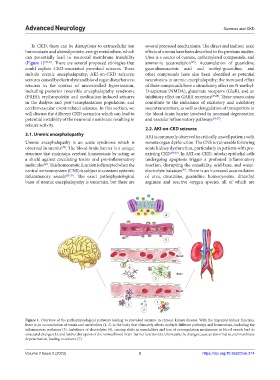
              In CKD, there can be disruptions to extracellular ion   several proposed mechanisms. The direct and indirect toxic
            homeostasis and altered protein-energy metabolism, which   effects of uremia have been described in the previous studies.
            can  potentially lead  to neuronal membrane instability   Urea is a source of cyanate, carbamylated compounds, and
            (Figure 1) [20,21] . There are several proposed etiologies that   ammonia accumulation . Accumulation of guanidine,
                                                                                  [26]
            could explain CKD-associated provoked seizures. These   guanidinosuccinic acid and methyl-guanidine, and
            include  uremic encephalopathy; AKI-on-CKD  seizures;   other  compounds  have  also  been  identified  as  potential
            seizures caused by electrolyte and blood sugar disturbances;   neurotoxins in uremic encephalopathy; the increased efflux
            seizures in the context of uncontrolled hypertension,   of these compounds have a stimulatory effect on N-methyl-
            including  posterior reversible  encephalopathy syndrome   D-aspartate (NMDA), glutamate receptors (GluR), and an
            (PRES); erythropoietin and medication-induced seizures   inhibitory effect on GABA receptors [27,28] . These neurotoxins
            in the dialysis and post-transplantation population; and   contribute to the imbalance of excitatory and inhibitory
            cerebrovascular event-related seizures. In this section, we   neurotransmitters, as well as deregulation of transporters in
            will discuss the different CKD scenarios which can lead to   the blood-brain barrier involved in neuronal degeneration
            potential instability of the neuronal membrane resulting in   and vascular inflammatory pathways [16,27] .
            seizure activity.
                                                               2.2. AKI-on-CKD seizures
            2.1. Uremic encephalopathy                         AKI is commonly observed in critically unwell patients with
            Uremic  encephalopathy  is  an  acute  syndrome  which  is   remote organ dysfunction. The CNS is vulnerable following
            observed in uremia . The blood-brain barrier is a unique   acute kidney dysfunction, particularly in patients with pre-
                           [22]
            structure that maintains cerebral homeostasis by acting as   existing CKD [29,30] . In AKI-on-CKD, tubular epithelial cells
            a shield against circulating toxins and pro-inflammatory   undergoing  apoptosis  trigger  a  profound  inflammatory
            molecules . This homeostatic function is disrupted when the   reaction, disrupting the osmolality, acid-base, and water-
                    [23]
            central nervous system (CNS) is subject to constant systemic   electrolyte balances . There is an increased accumulation
                                                                              [31]
            inflammatory assault [23-25] . The exact pathophysiological   of urea, creatinine, guanidine, homocysteine, dimethyl
            basis of uremic encephalopathy is uncertain, but there are   arginine and reactive oxygen species, all of which are


            Figure 1. Overview of the pathophysiological pathways leading to provoked seizures in chronic kidney disease. With the impaired kidney function,
            there is an accumulation of toxins and metabolites (1, 2) in the body that ultimately affects multiple different pathways and homeostasis, including the
            inflammatory pathways (3). Imbalance of electrolytes (4), causing shifts in osmolalities and loss of autoregulation mechanism in blood vessels lead to
            structural changes (5), and further disruption of the normal blood-brain-barrier function (6). Ultimately, the changes cause an abnormal neural membrane
            depolarization, leading to seizures (7).


                                                                                       https://doi.org/10.36922/an.314
            Volume 2 Issue 2 (2023) olume 2 Issue 2 (2023)   3  3                      https://doi.org/10.36922/an.314
            V

