


Page 9 - AN-2-2
P. 9
Advanced Neurology                                                  Venous stenting, intracranial hypertension


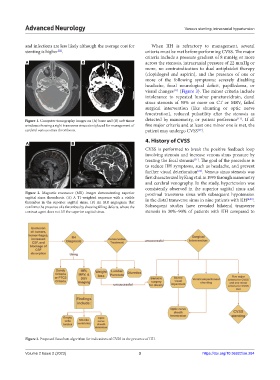
            and infections are less likely although the average cost for   When  IIH is  refractory to  management,  several
            stenting is higher .                               criteria must be met before performing CVSS. The major
                          [22]
                                                               criteria include a pressure gradient of 8 mmHg or more
            A                       B                          across the stenosis, intracranial pressure of 22 mmHg or
                                                               more, no contraindication to dual antiplatelet therapy
                                                               (clopidogrel and aspirin), and the presence of one or
                                                               more of the following symptoms: severely disabling
                                                               headache, focal neurological deficit, papilledema, or
                                                               visual changes [17]  (Figure 3). The minor criteria include
                                                               intolerance to repeated lumbar puncture/drain, dural
                                                               sinus stenosis of 50% or more on CT or MRV, failed
                                                               surgical intervention  (like shunting or  optic  nerve
                                                               fenestration), reduced pulsatility after the stenosis as
            Figure 1. Computer tomography images on (A) bone and (B) soft tissue   detected by manometry, or patient preference [17] . If all
            windows showing a right transverse sinus stent placed for management of   five major criteria and at least one minor one is met, the
            cerebral venous sinus thrombosis.                  patient may undergo CVSS [17] .
                                                               4. History of CVSS
            A                  B
                                                               CVSS is performed to break the positive feedback loop
                                                               involving stenosis and increase venous sinus pressure by
                                                               treating the focal stenosis . The goal of the procedure is
                                                                                   [21]
                                                               to reduce IIH symptoms, such as headache, and prevent
                                                               further visual deterioration . Venous sinus stenosis was
                                                                                     [21]
                                                               first characterized by King et al. in 1995 through manometry
                                                               and cerebral venography. In the study, hypertension was
                                                               consistently observed in the superior sagittal sinus and
            Figure  2. Magnetic resonance (MR) images demonstrating superior   proximal  transverse  sinus  with  subsequent  hypotension
            sagittal sinus thrombosis. (A) A T1-weighted sequence with a visible   in the distal transverse sinus in nine patients with IIH [4,23] .
            thrombus in the superior sagittal sinus. (B) An MR angiogram that
            confirms the presence of a thrombus by showing filling defects, where the   Subsequent studies have revealed bilateral transverse
            contrast agent does not fill the superior sagittal sinus.  stenosis in 30%–90% of patients with IIH compared to


            Figure 3. Proposed flowchart algorithm for indications of CVSS in the presence of IIH.


            Volume 2 Issue 2 (2023)                         3                          https://doi.org/10.36922/an.284

