


Page 25 - AN-4-4
P. 25
Advanced Neurology                                                   Graphene quantum dots approach in AD


            infrared detectors, and solar cells.  However, the shell of a   nanoparticles, having properties of both QDs and
                                      20
            QD consists of a wide-gap semiconductor – such as zinc   grapheme.  Due to their exceptional electro-optical
                                                                       22
            sulfide or cadmium sulfide – which passivates any surface   properties, biocompatibility, non-toxicity, and chemical
            defects and enhances quantum yield, thereby improving   stability, GQDs demonstrate excellent performance
            the stability and functionality of QDs.  This core–shell   across various fields, such as biotechnology, electronics,
                                            18
            configuration significantly enhances the performance of   and medicine. 23-28  Typically, GQDs have a size of <20 nm
            QDs, allowing them to be used in various applications.   in diameter.  The quantum confinement effect becomes
                                                                         29
            Hence, QDs are suitable for biological applications, including   more noticeable as the size of the dot decreases and
            medical imaging and biosensors, due to their nature and   approaches the bulk exciton’s Bohr radius.  In GQDs,
            size, which allow them to circulate throughout the body.   the  excitons  have a  limitless Bohr diameter,  making  the
            Moreover, QDs are widely used in tumor targeting, in vivo   quantum confinement effects more visible in graphene
            observation of cell trafficking, intracellular process studies,   fragments of varying sizes.  Thus, GQDs have exceptional
                                                                                    30
            diagnostics, and high-resolution cellular imaging.  Their   optoelectronic properties and are considered more
                                                    19
            high quantum yield, photostability, and tunable emission   desirable than other forms of QDs. Compared to graphene,
            spectrum make them significantly superior to conventional   GQDs have a tunable, non-zero band gap and fluorescence
            organic dyes.  Compared to traditional fluorescent dyes,   upon excitation. This band gap is tunable by altering the
                      20
            QDs  are  approximately  20  times  brighter  and  100  times   surface chemistry and size of the QD.  Another distinctive
                                                                                            30
            more stable. Li et al.  reported that QDs can be surface-  feature  of  GQDs  is  electrochemiluminescence,  where
                             19
            functionalized to improve their solubility, stability, and   they emit luminescence during electrochemical reactions.
            biocompatibility for certain uses. QDs also have exceptional   According  to  Eda  et al.,   the  electrical  properties  of
                                                                                    31
            photostability, making them perfect for applications in   GQDs can change depending on their size. GQDs are
            extremely sensitive cellular imaging.  This facilitates the   also known for their absorption and photoluminescence
                                         20
            high-resolution reconstruction of multiple successive focal-  characteristics, 21,32,33  which make them highly applicable
            plane images into three-dimensional images. By employing   in bioimaging,  biosensing, and optoelectronics. 35,36
                                                                            34
            peptides, antibodies, or ligands to target particular cells or   Furthermore, due to their low toxicity, high bioavailability,
            proteins, QDs can be used to examine the target protein or   excellent solubility in a wide range of solvents, and their
            the behavior of the cells.
                                                               ability to be equipped with functional groups, GQDs are
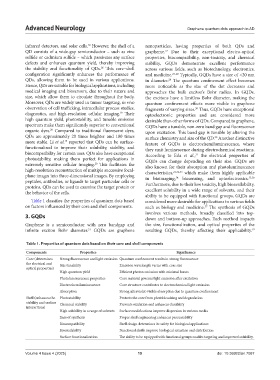
              Table 1 classifies the properties of quantum dots based   considered more desirable for applications in various fields
            on factors influenced by their core and shell components.  such as biology and medicine.  The synthesis of GQDs
                                                                                        37
                                                               involves various methods, broadly classified into top-
            3. GQDs                                            down and bottom-up approaches. Each method impacts
            Graphene is a semiconductor with zero bandgap and   the size, functionalization, and optical properties of the
            infinite exciton Bohr diameter.  GQDs are graphene   resulting GQDs, thereby affecting their applicability.
                                                                                                            19
                                       21
            Table 1. Properties of quantum dots based on their core and shell components
            Components             Properties                               Significance
            Core (determines   Strong fluorescence and light emission Quantum confinement results in strong fluorescence
            the electrical and   Size tunability    Emission wavelength varies with core size
            optical properties)
                          High quantum yield        Efficient photon emission with minimal losses
                          Photoluminescence properties  Core material governs light emission after excitation
                          Electrochemiluminescence  Core structure contributes to electrochemical light emission
                          Absorption                Strong ultraviolet-visible absorption due to quantum confinement
            Shell (enhances the  Photostability     Protects the core from photobleaching and degradation
            stability and surface   Chemical stability  Prevents oxidation and enhances durability
            interactions)
                          High solubility in a range of solvents  Surface modifications improve dispersion in various media
                          Ease of synthesis         Proper shell engineering enhances processability
                          Biocompatibility          Shell design determines its safety for biological applications
                          Bioavailability           Functional shells improve biological retention and distribution
                          Surface functionalization  The ability to be equipped with functional groups enables targeting and improved solubility.


            Volume 4 Issue 4 (2025)                         19                               doi: 10.36922/an.7087

