


Page 28 - AN-4-4
P. 28
Advanced Neurology                                                   Graphene quantum dots approach in AD


            associated with increased tau phosphorylation, memory   NFTs disrupts synaptic connections, further contributing
            deficits, and high levels of Aβ peptide accumulation.    to neurotoxicity and cell death. 56,57
                                                         52
            A study on transgenic mouse models of AD found that   Based on the onset of the disease, AD can be categorized
            hyperhomocysteinemia leads to increased Aβ peptide   into late-onset AD (LOAD), sporadic AD (SAD) (also
            accumulation,  tau phosphorylation, and memory     known as early-onset AD), and familial AD.
            deficits.  Furthermore, another study reported the use of a
                  52
            transgenic Caenorhabditis elegans model expressing the Aβ   6. LOAD
            peptide in muscle cells to analyze the effects of vitamin B12
            deficiency on Aβ toxicity. The result showed that the levels   The genetic basis of LOAD appears to be very complex. It
            of  homocysteine  and  methylmalonic  acid  accumulation   involves several interactions between multiple genetic and
            were higher in vitamin B12-deficient worms than in worms   environmental factors. Although many cases are sporadic
            without vitamin B12 deficiency,  along with an increased   without familial links, the presence of mutated forms of

                                     53
            rate of paralysis in the vitamin B12-deficient worms.  apolipoprotein E (ApoE)  ε4  allele on chromosome 19q13
                                                               significantly increases susceptibility. ApoE, which is primarily
            5.1. Tau hyperphosphorylation                      produced by astrocytes and microglia and, to a lesser degree,
            In  AD,  intraneuronal  NFTs  are  formed,  consisting  of   by neurons in the CNS, mediates Aβ transport into the CNS,
            paired helical filaments (PHFs) and 2.1 mm tau filaments.   facilitating plaque formation. Variants of ApoE encoded by
            The main components of the PHFs are the microtubule-  codons 112 and 158 of the ApoE gene distinctly influence AD
            associated tau protein.  Tau is encoded by the microtubule-  risk, with ApoEε4 increasing the risk while ApoEε2 reduces
                             54
                                                                            58
            associated tau protein gene through alternative splicing and   the risk of AD.  Furthermore, some recently identified
            is primarily localized within microtubules and neuronal   LOAD-related proteins include apolipoprotein J (clusterin),
            axons in the brain, where it regulates their stability, synaptic   which aids in Aβ peptide chaperoning; translocase of
            integrity, and signaling. Normally, tau phosphorylation is   outer mitochondrial membrane 40 protein, involved in
            balanced by kinase and phosphatase activities. However, in   mitochondrial protein transport; and sortilin-related
                                                                                                            59
            AD, this balance becomes disrupted, resulting in excessive   receptor, which regulates APP interactions with secretases.
            tau phosphorylation.  This hyperphosphorylation alters   Some modifiable factors, including hypertension, diabetes,
                             55
            tau’s structure, leading to impaired microtubule binding   obesity, smoking, hyperhomocysteinemia, cardiovascular
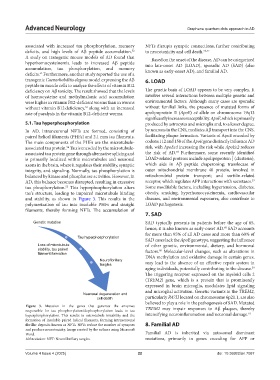
            and stability, as shown in  Figure  3. This results in the   diseases, and environmental exposures, also contribute to
            polymerization of tau into insoluble PHFs and straight   LOAD pathogenesis.
            filaments, thereby forming NFTs. The accumulation of
                                                               7. SAD
               Genetic mutation                                SAD typically presents in patients before the age of 65,
                                                               hence, it is also known as early-onset AD.  SAD accounts
                                                                                                60
                                                               for more than 95% of all AD cases and more than 60% of
                                  Tau hyperphosphorylation
                                                               SAD cases lack the ApoE genotype, suggesting the influence
                 Loss of microtubule                           of other genetic, environmental, dietary, and hormonal
                 stability, tau paired                         factors.  Molecular-level changes, such as alterations in
                                                                     60
                 filament formation
                                           Neurofibrillary     DNA methylation and oxidative damage in certain genes,
                                           tangles             may lead to the absence of an effective repair system in
                                                               aging individuals, potentially contributing to the disease.
                                                                                                            59
                                                               The triggering receptor expressed on the myeloid cells 2
                                                               (TREM2) gene, which is a protein that is prominently
                                                               expressed in brain microglia, modulates lipid signaling
                                                               and microglial activation. Genetic variants in the TREM2,
                                    Neuronal degeneration and
                                          cell death           particularly R47H located on chromosome 6p21.1, are also
                                                               believed to play a role in the pathogenesis of SAD. Mutated
            Figure  3. Mutation in the genes that generate the enzymes   TREM2  may  impair  responses  to  Aβ  plaques,  thereby
            responsible for tau phosphorylation/dephosphorylation leads to tau
            hyperphosphorylation. This results in microtubule instability and the   intensifying neuroinflammation and neuronal damage. 61
            formation of insoluble paired helical filaments, forming intraneuronal
            fibrillar deposits known as NFTs. NFTs reduce the number of synapses   8. Familial AD
            and produce neurotoxicity. Image created by the authors using Microsoft
            Word.                                              Familial AD is inherited via autosomal dominant
            Abbreviation: NFT: Neurofibrillary tangles.        mutations, primarily in genes encoding for APP or


            Volume 4 Issue 4 (2025)                         22                               doi: 10.36922/an.7087

