


Page 37 - ARNM-1-1
P. 37
Advances in Radiotherapy
            & Nuclear Medicine                                       SIR-spheres Y-90 resin microspheres for HCC treatment


            Table 2. SIRT treatment information                Table 3. Tumor response by mRECIST 3 and 6 months
                                                               after SIRT
            Treatment or tumor feature       Frequency or mean
            Dosimetry method (n [%])                           mRECIST response, n (%)  3 Months (n=30)  6 Months (n=22)
             BSA                                14 (46.7)      Complete response      7 (23.3)      7 (31.8)
             Partition model                    16 (53.3)      Partial response       16 (53.3)     11 (50.0)
             Tumor dose, Gy (mean [SD])        179.2 (80.3)    Stable disease          6 (20)        2 (9.1)
             Normal liver dose, Gy (mean [SD])  28.1 (10)      Progressive disease     1 (3.3)       2 (9.1)
             Lung dose, Gy (mean [SD])          3.5 (3.2)      Abbreviations: mRECIST: Modified response evaluation criteria in
                                                               solid tumors; SIRT: Selective internal radiation therapy.
            Liver volume, cm  (mean [SD])
                       3
             Whole                            1436.1 (301.5)   4. Discussion
             Right lobe                       1010.5 (297.5)
             Left lobe                          407 (192)      We provide the first data report from Vietnam on using
            Prescribed activity, GBq (mean [SD])               SIRT to treat patients with unresectable HCC and
                                                               confirm the safety and effectiveness of SIRT in clinical
             Whole liver                          1.9          practice. While 19 patients reported AEs, most were mild
             Right lobe                         1.3 (0.4)      to moderate in severity. At 3 and 6 months, most tumor
             Left lobe                            1.2          responses were CR and PR; no patients died during the
            SIRT treatment target                              6 months after SIRT.
             Whole liver (single catheter) (n [%])  1 (3.3)      It is unclear from published reports whether the
             Whole liver (sequential lobar) (n [%])  1 (3.3)   etiology of HCC affects treatment efficacy . Hepatitis
                                                                                                   [11]
             Right lobe (n [%])                 27 (90.0)      B virus (HBV) is a common risk factor for HCC and is
                                                                                     [14]
            Left lobe (n [%])                    1 (3.3)       highly endemic in Vietnam . A recent report indicated
            Abbreviations: BSA: Body surface area; SIRT: Selective internal   that advanced-staged HCC was strongly associated with
            radiation therapy.                                 HBV in a cohort of patients in Hanoi; 81.3% of the patients
                                                               with HCC were infected with HBV . However, a study
                                                                                            [15]
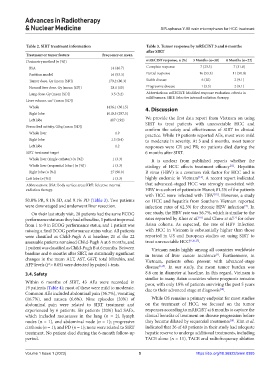
            50.0% PR, 9.1% SD, and 9.1% PD (Table 3). Two patients   on HCC and hepatitis from Southern Vietnam reported
            were downstaged and underwent liver resection.     infection rates of 62.3% for chronic HBV infection . In
                                                                                                         [3]
              On their last study visit, 28 patients had the same ECOG   our study, the HBV rate was 56.7%, which is similar to the
                                                                                                    [7]
                                                                                     [10]
            performance status as they had at baseline, 1 patient improved   rates reported by Khor et al.  and Chow et al.  for other
            from 1 to 0 in ECOG performance status, and 1 patient was   Asian cohorts. As expected, the rate of HBV infection
            missing a final ECOG performance status value. All patients   with HCC in Vietnam is substantially higher than those
            were classified as Child-Pugh A at baseline; 21 of the 22   reported in US and European studies on using SIRT to
            assessable patients remained Child-Pugh A at 6 months, and   treat unresectable HCC [9,16,17] .
            1 patient was classified as Child-Pugh B at 6 months. Between   Vietnam ranks highly among all countries worldwide
            baseline and 6 months after SIRT, no statistically significant   in terms of liver cancer incidence . Furthermore, in
                                                                                             [1]
            changes in the mean ALT, AST, GGT, total bilirubin, and   Vietnam, patients often present with advanced-stage
            AFP levels (P > 0.05) were detected by paired t-tests.  disease [3,15] . In our study, the mean tumor burden was
            3.4. Safety                                        8.6 cm in diameter at baseline. In this regard, Vietnam is
                                                               similar to many Asian countries where prognosis remains
            Within  6  months  of  SIRT,  43  AEs  were  recorded  in   poor, with only 18% of patients surviving the past 5 years
            19 patients (Table 4); most of these were mild to moderate.   due to their advanced stage at diagnosis .
                                                                                              [18]
            Common AEs included abdominal pain (36.7%), vomiting
            (16.7%), and nausea (6.6%). Nine episodes (20%) of   While OS remains a primary endpoint for most studies
            abdominal pain were related to SIRT treatment and   on the treatment of HCC, we focused on the tumor
            experienced by 6 patients. Six patients (20%) had SAEs,   responses according to mRECIST at 6 months to capture the
            which included metastases in the lung (n = 2), lymph   clinical benefits of treatment on disease progression before
                                                                                                   [19]
            nodes (n = 1), and abdominal node (n = 1); progressive   they became diluted by sequential treatments . Kim et al.
            cirrhosis (n = 1); and PD (n = 1); none were related to SIRT   indicated that 26 of 40 patients in their study had adequate
            treatment. No patient died during the 6-month follow-up   hepatic reserve to undergo additional treatments, including
            period.                                            TACE alone (n = 11), TACE and radiofrequency ablation


            Volume 1 Issue 1 (2023)                         5                       https://doi.org/10.36922/arnm.0385

