


Page 10 - ARNM-2-1
P. 10
Advances in Radiotherapy
            & Nuclear Medicine                                                 Pediatric myelosuppression in radiotherapy


            of pediatric oncology patients compared to adult patients.   a young adult group (>10 years old) with a boundary of
            Literature suggests that strategies  for protecting critical   10 years old for further analysis.
            organs in children should be differentiated from those
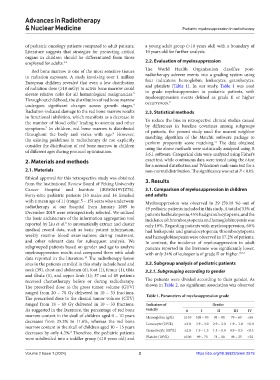
            employed for adults. 2-4                           2.2. Evaluation of myelosuppression
              Red bone marrow is one of the most sensitive tissues   The World Health Organization classifies post-
            to radiation exposure. A  study involving over 1 million   radiotherapy adverse events into a grading system using
            European children revealed that even a low distribution   four indicators: hemoglobin, leukocytes,  granulocytes,
            of radiation dose (≥10 mGy) to active bone marrow could   and platelets (Table 1). In our study,  Table 1 was used
            elevate relative risks for all hematological malignancies.    to grade myelosuppression in pediatric patients, with
                                                          5
            Throughout childhood, the distribution of red bone marrow   myelosuppression  events  defined  as  grade  II  or  higher
                                                                         6
            undergoes  significant  changes  across  growth  stages.    occurrences.
                                                          4
            Radiation-induced damage to the red bone marrow results   2.3. Statistical methods
            in functional inhibition, which manifests as a decrease in
            the number of blood cells,  leading to anemia and other   To reduce the bias in retrospective clinical studies caused
                                  6
            symptoms.  In children, red bone marrow is distributed   by differences in baseline covariates among subgroups
                    7
                                                 8
            throughout  the  body  and  varies  with  age.   However,   of patients, the present study used the nearest neighbor
                                                               matching algorithm of the MatchIt software package to
            the existing guidelines in radiotherapy do not explicitly   perform propensity score matching.  The data obtained
                                                                                            11
            consider the distribution of red bone marrow in children   using the above methods were statistically analyzed using R
            of different ages during protocol optimization.
                                                               3.6.1 software. Categorical data were analyzed using Fisher’s
            2. Materials and methods                           exact test, while continuous data were tested using the t-test
                                                               for a normal distribution and Wilcoxon’s rank-sum test for a
            2.1. Materials                                     non-normal distribution. The significance was set at P < 0.05.
            Ethical approval for this retrospective study was obtained   3. Results
            from the Institutional Review Board of Peking University
            Cancer  Hospital  and Institute  (IRB#2019YJZ76).   3.1. Comparison of myelosuppression in children
            Forty-nine pediatric patients (33  males and 16  females)   and adults
            with a mean age of 11 (range: 5 – 15) years who underwent   Myelosuppression was observed in 29  (59.18 %) out of
            radiotherapy at our hospital from  January 2009 to   49 pediatric patients included in this study. A total of 53% of
            December 2019 were retrospectively selected. We utilized   patients had leukopenia, 45% had granulocytopenia, and the
            the basic architecture of the information aggregation tool   incidence of thrombocytopenia and hemoglobinopenia was
            reported by Liu et al.  to automatically extract and cluster   only 10%. Regarding patients with myelosuppression, 66%
                             9
            medical record data, such as basic patient information,   had leukopenia and granulocytopenia; thrombocytopenia
            weekly routine blood examinations during treatment,   and hemoglobinopenia were observed in 17.2% of patients.
            and other relevant data for subsequent analysis. We   In contrast, the incidence of myelosuppression in adult
            subgrouped patients based on gender and age to analyze   patients reported in the literature was significantly lower,
            myelosuppression results and compared them with adult   with only 34% of leukopenia of grade II or higher. 10,12
            data reported in the literature.  The radiotherapy lesion
                                     10
            sites in the patients enrolled in this study include head and   3.2. Subgroup analysis of pediatric patients
            neck (39), chest and abdomen (6), foot (1), femur (1), tibia   3.2.1. Subgrouping according to gender
            and fibula (1), and upper limb (1); 37 out of 49 patients
            received chemotherapy before or during radiotherapy.   The patients were divided according to their gender. As
            The prescribed dose to the gross tumor volume (GTV)   shown in Table 2, no significant association was observed
            ranged from 20 – 70  Gy delivered in 10 – 33 fractions.
            The prescribed dose to the clinical tumor volume (CTV)   Table 1. Parameters of myelosuppression grade
            ranged from 18 – 60  Gy delivered in 10 – 33 fractions.   Indicators of        Grades
            As suggested in the literature, the percentage of red bone   toxicity  0   I     II     III   IV
            marrow content in the skull of children aged 0 – 10 years   Hemoglobin (g/L)  ≥110  109 – 95  94 – 80  79 – 65  <65
            decreases from 25.3% to 11.6%, whereas the red bone   Leucocyte (10 /L)  ≥4.0  3.9 – 3.0  2.9 – 2.0  1.9 – 1.0  <1.0
                                                                        9
            marrow content in the skull of children aged 10 – 15 years    9
            decreases by only 4.3%.  Therefore, the pediatric patients   Granulocyte (10 /L)  ≥2.0  1.9 – 1.5  1.4 – 1.0  0.9 – 0.5  <0.5
                               8
                                                                      9
            were subdivided into a toddler group (≤10 years old) and   Platelet (10 /L)  ≥100  99 – 75  74 – 50  49 – 25  <25
            Volume 2 Issue 1 (2024)                         2                       https://doi.org/10.36922/arnm.2519

