


Page 12 - ARNM-2-1
P. 12
Advances in Radiotherapy
            & Nuclear Medicine                                                 Pediatric myelosuppression in radiotherapy


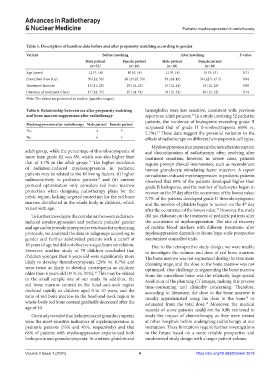
            Table 5. Description of baseline data before and after propensity matching according to gender
            Variant                          Before matching                  After matching           P‑value
                                     Male patient    Female patient   Male patient   Female patient
                                       (n=33)           (n=16)          (n=10)          (n=10)
            Age (years)                12 (9, 14)      10 (9, 14)      11 (9, 14)       10 (9, 13)      0.71
            Prescribed dose (Gy)      30 (22, 56)     40 (23.25, 50)   30 (24, 49)    38 (22.5, 47.5)   0.94
            Treatment fraction        15 (11, 28)      20 (12, 25)     15 (12, 24)     19 (11, 24)      0.88
            Duration of treatment (days)  17 (14, 35)  27 (14, 31)     19 (15, 32)     28 (15, 32)      0.74
            Note: The values are presented as median (quartile ranges).
            Table 6. Relationship between sex after propensity matching   hemoglobin were less sensitive, consistent with previous
            and bone marrow suppression after radiotherapy     reports on adult patients.  In a study involving 52 pediatric
                                                                                   17
                                                               patients, the  incidence  of  leukopenia  exceeding  grade  II
            Myelosuppression after radiotherapy Male patient Female patient  surpassed that of grade  II thrombocytopenia (69%  vs.
            Yes                           4         5          5.7%).  These data suggest the potential variation in the
                                                                    17
            No                            6         5          effects of radiotherapy on different hematopoietic cell types.
                                                                 Myelosuppression is an important factor in the interruption
            adult group, while the percentage of thrombocytopenia of   and discontinuation of radiotherapy, often resolving after
            more than grade III was 8%, which was also higher than   treatment cessation;  however, in  severe  cases,  patients
                                       13
            that of 4.7% in the adult group.  The higher incidence   require prompt clinical intervention, such as recombinant
            of radiation-induced myelosuppression  in pediatric   human granulocyte stimulating factor injection. A  report
            patients may be related to the following factors: (i) higher   on radiation-induced myelosuppression in pediatric patients
            radiosensitivity in pediatric patients  and (ii) current   observed that 69% of the patients developed higher than
                                          15
            protocol optimization only considers red bone marrow   grade II leukopenia, and the number of leukocytes began to
            protection when designing radiotherapy plans for the   recover on the 5  day after the occurrence of the lowest value;
                                                                           th
            pelvic region, lacking targeted protection for the red bone   5.7% of the patients developed grade II thrombocytopenia;
            marrow distributed in the whole body in children, which   and the number of platelets began to recover on the 4  day
                                                                                                         th
            varied with age.                                   after the occurrence of the lowest value.  However, the study
                                                                                             17
              To further investigate the correlation between radiation-  did not elaborate on the treatment of pediatric patients after
            induced myelosuppression and pediatric patients’ gender   the occurrence of myelosuppression. The rate of recovery
            and age and to provide more precise evidence for optimizing   of routine blood markers with different treatments after
            protocols, we analyzed the data in subgroups according to   myelosuppression depends on future large-scale prospective
            gender  and further  subdivided  patients with  a  cutoff of   randomized controlled trials.
            10 years of age but did not observe a significant correlation.   Due to the retrospective study design, we were unable
            However, another study of 79 children concluded that   to investigate the volume and dose of red bone marrow.
            children younger than 6 years old were significantly more   The bone marrow was not segmented during the treatment
            likely to develop thrombocytopenia (29% vs. 8.7%) and   planning stage, and the dose to the bone marrow was not
            were twice as likely to develop neutropenia as children   optimized. One challenge in segmenting the bone marrow
            older than 6 years old (41% vs. 21%).  This may be related   from the cancellous bone was the relatively large spatial
                                         16
            to the small sample size of our study. In addition, the   resolution of the planning CT images, making this process
            red bone marrow content in the head-and-neck region   time-consuming and clinically concerning. Therefore,
            declined rapidly in children aged 0 to 10 years, and the   according  to  literature,  the  dose  to  the  bone  marrow  is
            ratio of red bone marrow in the head-and-neck region to   usually approximated using the dose to the bone  or
                                                                                                         18
            whole-body red bone content gradually decreased after the   estimated from the total dose.  Moreover, the medical
                                                                                        14
            age of 10.                                         records of some patients could not be fully retrieved to
              Our study revealed that leukopenia and granulocytopenia   study the impact of chemotherapy, as they were treated
            were the most sensitive indicators of myelosuppression in   at other hospitals before undergoing radiotherapy at our
            pediatric  patients  (53%  and  45%,  respectively)  and  that   institution. These limitations require further investigations
            66% of patients with myelosuppression experienced both   in  the  future  based  on  a  more  reliable  prospective  and
            leukopenia and granulocytopenia. In contrast, platelets and   randomized study design with a larger patient volume.


            Volume 2 Issue 1 (2024)                         4                       https://doi.org/10.36922/arnm.2519

