


Page 16 - ARNM-2-1
P. 16
Advances in Radiotherapy
            & Nuclear Medicine                                                 Blood glucose and I-123 MIBG lung uptake


              Diabetes has been linked to the increased uptake and   with low-energy, high-resolution collimator, with an
            retention of MIBG in the lung due to the dysfunction of   energy window of 159 keV ± 7.5, was used in this study.
            sympathetic nerve. 7-10  It is also believed that the enhanced   I-123 MIBG with a dosage of 110 – 370 MBq was
            permeability  of the  pulmonary endothelial  cells  could   injected slowly through intravenous mode. Whole-body
            also increase the uptake of MIBG in the lung.  A study   planar image, from head to thigh, was acquired at 24-h
                                                  11
            conducted by  Hempel  et  al.  found that  high  glucose   post-injection with bed speed of 6 cm/min.
            concentration could increase the permeability of the
            endothelial cell.  To  the best  of our knowledge, lung   2.2.2. Image analysis
                         12
            uptake of MIBG in non-diabetic patients has never been
            reported in the literature.                        Image analysis was performed semi-quantitatively
                                                               (Figure 2). A region of interest (ROI), measuring 2 × 3 cm ,
                                                                                                            2
              The aim of this study was to evaluate the correlation   was drawn manually and placed on the right-middle
            between blood glucose and lung uptake of MIBG and to   lung and on the mediastinum to calculate the lung-to-
            compare the difference in lung uptake of MIBG between   mediastinum ratio (LMR).
            diabetic and non-diabetic patients.
                                                               2.2.3. Statistical analysis
            2. Materials and methods
                                                               Data  are  expressed  as  mean ±  standard  deviation (SD).
            2.1. Materials                                     Pearson’s correlation test was used to evaluate the statistical
            All patients who underwent I-123 MIBG whole-body scan   significance between the uptake of I-123 MIBG in the lung
            (WBS)  in  the  Department  of  Nuclear  Medicine,  Seoul   and the fasting glucose level. The Pearson’s coefficient
            National University Hospital (SNUH), between January   (r) values were stratified into three groups, based on the
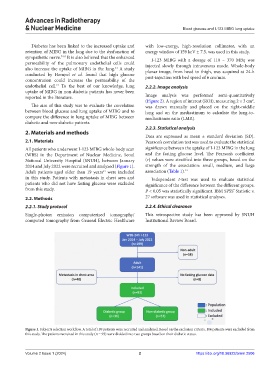
            2014 and July 2022 were recruited and analyzed (Figure 1).   strength of the association: small, medium, and large
            Adult patients aged older than 19  years  were included   association (Table 1). 14
                                             13
            in this study. Patients with metastasis in chest area and   Independent  t-test was used to evaluate statistical
            patients who did not have fasting glucose were excluded   significance of the difference between the different groups.
            from this study.                                   P < 0.05 was statistically significant. IBM SPSS  Statistic v.
                                                                                                    ®
            2.2. Methods                                       27 software was used in statistical analyses.
            2.2.1. Study protocol                              2.2.4. Ethical clearance
            Single-photon emission computerized tomography/    This retrospective study has been approved by SNUH
            computed tomography from General Electric Healthcare   Institutional Review Board.


            Figure 1. Subjects selection workflow. A total of 199 patients were recruited and analyzed. Based on the exclusion criteria, 106 patients were excluded from
            this study. The patients recruited in this study (n = 93) were divided into two groups based on their diabetic status.


            Volume 2 Issue 1 (2024)                         2                       https://doi.org/10.36922/arnm.2506

