


Page 17 - ARNM-2-1
P. 17
Advances in Radiotherapy
            & Nuclear Medicine                                                 Blood glucose and I-123 MIBG lung uptake


            3. Results

            3.1. Patients’ characteristics
            A total of 199  patients had undergone I-123 MIBG
            whole body scan from January 2014 to July 2022. A total
            106  patients were excluded from this study, with 58 of
            them being non-adult patients, 40 having metastasis
            in chest area, and eight having no fasting glucose data.
            Ninety-three patients were included in this study and
            were divided into two groups based on their diabetic
            status. Diabetic group consisted of 36 patients (21 males
            and 15  females), while non-diabetic group consisted of
            57 patients (28 males and 29 females), with mean age of
            56 ± 14.1 years and 52 ± 14.6 years, respectively. Patients’
            characteristics of both diabetic and non-diabetic groups
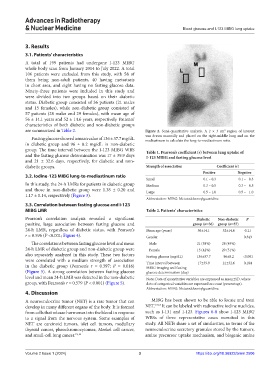
            are summarized in Table 2.                         Figure  2.  Semi-quantitative  analysis.  A  2  ×  3 cm   region  of interest
                                                                                                 2
                                                               was drawn manually and placed on the right-middle lung and on the
              Fasting glucose showed a mean value of 136 ± 37.7 mg/dL   mediastinum to calculate the lung-to-mediastinum ratio.
            in diabetic group and 96 ± 8.2  mg/dL in non-diabetic
            group. The time interval between the I-123 MIBG WBS   Table 1. Pearson’s coefficient (r) between lung uptake of
            and the fasting glucose determination was 17 ± 39.9 days   I‑123 MIBG and fasting glucose level
            and 21 ± 32.6  days, respectively, for diabetic and non-
            diabetic groups.                                   Strength of association       Coefficient (r)
                                                                                       Positive       Negative
            3.2. Iodine-123 MIBG lung-to-mediastinum ratio
                                                               Small                    0.1 – 0.3     −0.1 – −0.3
            In this study, the 24-h LMRs for patients in diabetic group   Medium        0.3 – 0.5     −0.3 – −0.5
            and those in non-diabetic group were 1.38 ± 0.20 and   Large                0.5 – 1.0     −0.5 – −1.0
            1.17 ± 0.14, respectively (Figure 3).
                                                               Abbreviation: MIBG: Metaiodobenzylguanidine.
            3.3. Correlation between fasting glucose and I-123
            MIBG LMR                                           Table 2. Patients’ characteristics
            Pearson’s correlation analysis revealed a significant                    Diabetic   Non‑diabetic   P
            positive, large association between fasting glucose and                group (n=36)  group (n=57)
            24-h LMR, regardless of diabetic status, with Pearson’s   Mean age (years)  56±14.1  52±14.6  0.21
            r = 0.596 (P <0.001; Figure 4).                    Gender                                    0.343
              The correlations between fasting glucose level and mean   Male         21 (58%)  28 (49%)
            24-h LMR of diabetic group and non-diabetic group were   Female          15 (42%)  29 (51%)
            also separately analyzed in this study. These two factors   Fasting glucose (mg/dL)  136±37.7  96±8.2  <0.001
            were  correlated  with  a  medium  strength  of  association   Time interval between   17±39.9  21±32,6  0.184
            in the diabetic group (Pearson’s  r = 0.397;  P  = 0.016)   MIBG imaging and fasting
            (Figure  5). A  strong correlation between fasting glucose   glucose determination (day)
            level and mean 24-h LMR was detected in the non-diabetic   Note: Data of quantitative variables are expressed as mean±SD, where
            group, with Pearson’s r = 0.579 (P < 0.001) (Figure 5).  data of categorical variables are expressed as count (percentage).
                                                               Abbreviation: MIBG: Metaiodobenzylguanidine.
            4. Discussion
            A neuroendocrine tumor (NET) is a rare tumor that can   MIBG has been shown to be able to locate and treat
            develop in many different organs of the body. It is formed   NET. 17,18  It can be labeled with radioactive iodine nuclides,
            from cells that release hormones into the blood in response   such as I-131 and I-123.  Figures  6-8 show I-123 MIBG
            to a signal from the nervous system. Some examples of   WBSs of three representative cases recruited in this
            NET are carcinoid tumors, islet cell tumors, medullary   study. All NETs share a set of similarities, in terms of the
            thyroid cancer, pheochromocytomas, Merkel cell cancer,   neuroendocrine secretory granules stored by the tumors,
            and small-cell lung cancer. 15,16                  amine precursor uptake mechanism, and biogenic amine


            Volume 2 Issue 1 (2024)                         3                       https://doi.org/10.36922/arnm.2506

