


Page 40 - ARNM-2-2
P. 40
Advances in Radiotherapy
            & Nuclear Medicine                                          Hypofractionated radiotherapy in craniopharyngioma


            3. Results                                         (CK), and 55 Gy (HT) in 5, 5, 15, 15, and 30 fractions,
                                                               respectively. Only one adult patient (12.5%) had received
            Two patients (25%) received RT under general anesthesia.   tetraiodothyronine or thyroxine (T4) replacement therapy
            The median time between surgery and RT was 8.5 months   before RT, and she had a complete response after H-IMRT
            (2.6 – 11 months). The largest mean diameter of the tumors   and did not need any additional hormone therapy except
            was 30.3 mm (18 – 45 mm).                          for the same dose of T4.
              Patients included in the study were aged 4 – 26 (median:   Before RT, 6 patients (75%) were using glucocorticoids
            14  years). Tumor volumes ranged from 4.8 to 31.2 cc   and thyroid hormone replacement therapy, 4  patients
            (median: 12.2 cc). The patient, tumor, and treatment   (50%) were using desmopressin, and 1  patient (12.5%)
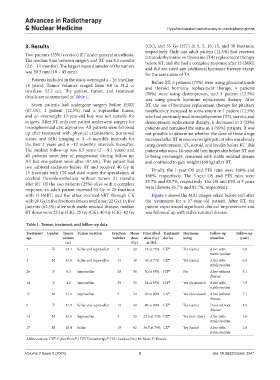
            details are summarized in Table 1.
                                                               was using growth hormone replacement therapy. After
              Seven patients had undergone surgery before EBRT   RT, the use of hormone replacement therapy for pituitary
            (87.5%), 1  patient (12.5%) had a suprasellar tumor,   insufficiency increased to some extent in 1 patient (12.5%)
            and an overweight 13-year-old boy was not suitable for   who had previously used triiodothyronine (T3), steroid, and
            surgery. After RT, only one patient underwent surgery for   desmopressin replacement therapy; it decreased in 2 (25%)
            transsphenoidal cyst aspiration. All patients were followed   patients and remained the same in 4 (50%) patients. It was
            up after treatment with physical examination, hormonal   not possible to determine whether the dose of these drugs
            status, and MRI imaging at 3 –6  monthly intervals for   increased after RT in one overweight patient who was already
            the first 2  years and 6 –12  monthly intervals thereafter.   using desmopressin, T3, steroid, and insulin before RT. This
            The median follow-up was 6.5 years (2 – 9.1 years) and   patient who was a 14-year-old boy, inoperable before RT due
            all patients were free of progression during follow-up.   to being overweight, remained with stable residual disease
            All but one patient were alive (87.5%). This patient had   and continued to gain weight (168 kg) after RT.
            two subtotal excisions before RT and received 40  Gy in
            15 fractions with CK and died under the speculation of   Finally, the 1-year OS and PFS rates were 100% and
            cerebral thromboembolism without tumor 21  months   100%, respectively. The 3-year OS and PFS rates were
            after RT. Of the two patients (25%) alive with a complete   85.7% and 85.7%, respectively. The OS and PFS at 5 years
            response, an adult patient received 50 Gy in 25 fractions   were likewise 85.7% and 85.7%, respectively.
            with H-IMRT, and the other received SRT through CK   Figure 1 shows the MRI images taken before and after
            with 20 Gy in five fractions (mean total dose: 22 Gy). In five   the treatments for a 17-year-old patient. After RT, the
            patients (62.5%) alive with stable residual disease, median   patient experienced significant clinical improvement and
            RT doses were 22 Gy (CK), 25 Gy (CK), 40 Gy (CK), 42 Gy   was followed up with stable residual disease.

            Table 1. Tumor, treatment, and follow‑up data
            Treatment  Gender  Tumor  Tumor location  Fraction  Mean  Prescribed  Treatment  Hormone   Follow‑up   Follow‑up
            age             volume               number  dose   dose (Gy)  device  using  situation    (year)
                             (cc)                        (Gy)  at IDL
            4          F     21.4  Sellar and suprasellar        5  22  18 at 71%  CK ®  Yes (same)  Alive with   6.0
                                                                                          stable residue
            4          M     14.6  Sellar and suprasellar  15  40  36 at 77%  CK ®  Yes (same)  Alive with   6.0
                                                                                          stable residue
            26         F     9.3  Suprasellar      25     50   50 at 95%  HT ®  No        Alive without   9.1
                                                                                          disease
            14         F     4.8  Suprasellar      30     55   54 at 95%  HT ®  Yes (increased)  Alive with   7.9
                                                                                          stable residue
            15         M     31.2  Suprasellar         5  22   20 at 80%  CK ®  Yes (decreased) Alive without   7.1
                                                                                          disease
            8          F     11.9  Sellar and suprasellar  15  42  40 at 80%  CK ®  Yes (same)  Dead without   1.8
                                                                                          disease
            14         M     12.6  Suprasellar         5  25  22.5 at 77% CK ®  Yes (not clear)  Alive with   5.0
                                                                                          stable residue
            17         M     10.4  Sellar          15     42  36.5 at 79% CK ®  Yes (same)  Alive with   2.0
                                                                                          stable residue
                        ®
            Abbreviations: CK : CyberKnife ; HT : Tomotherapy ; IDL: Isodose line; M: Male; F: Female.
                                 ®
                                               ®
                                     ®
            Volume 2 Issue 2 (2024)                         3                              doi: 10.36922/arnm.3041

