


Page 42 - ARNM-2-2
P. 42
Advances in Radiotherapy
            & Nuclear Medicine                                          Hypofractionated radiotherapy in craniopharyngioma


            5 years. 10,11  Iannalfi et al. have conducted a review on the   event-free survival was statistically higher with the use of
            use of RT in craniopharyngioma.  The studies analyzed   modern imaging techniques and doses of 55 Gy and above.
                                                                                                             3
                                       12
            used conventional RT schemes, including two-dimensional   All patients in this study received RT using megavoltage
            and three-dimensional RT, as well as fractionated SRT   machines; Cobalt 60 in 16 (43%), 4 MV X-rays in 6, and
            techniques. The doses applied ranged from 42.5 to 62.4 Gy,   ≥17 MV X-rays in 15 patients. Total dose ranged between
            with a dose of 1.8 – 2 Gy per fraction. The 5-year PFS or   45 and 56 Gy (median 50), and target volume consisted
            local control rates varied between 75% and 100%. Our   of GTV with a safety margin of 2 cm in each diameter.
            study found a 5-year PFS rate of 85.7%, which is consistent   In most cases (63%), simple beams setting through two-
            with the literature, suggesting that HFRT provides   opposed parallel beams were used. For some patients
            tumor  control  similar  to  conventional  fractionation.    with tumors located above the base of the skull, multiple
                                                         12
            Therefore, even with older technology, RT outcomes for   beams technique (27%) were used. Field size varied from
            craniopharyngioma remain satisfactory.             5 × 5 cm to 11 × 12 cm (median 6 × 6 cm). In this study,
                                                               the field size utilized was much smaller and the margins
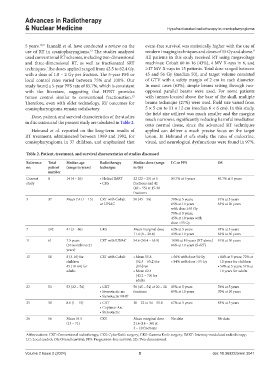
              Dose, patient, and survival characteristics of the studies
            in discussion and the present study are tabulated in Table 2.  much narrower, significantly reducing harmful irradiation
                                                               onto normal tissue, since the advanced RT techniques
              Habrand  et al. reported on the long-term results of   applied  can deliver  a much precise focus  on the target
            RT treatment, administered between 1969 and 1992, for   lesion. In Habrand  et al.’s study, the rates of endocrine,
            craniopharyngioma in 37 children, and emphasized that   visual, and neurological dysfunctions were found in 97%,

            Table 2. Patient, treatment, and survival characteristics of studies discussed
            Reference   Total   Median age   Radiotherapy   Median dose (range   LC or PFS    OS
            no.      patient   (range in years)  technique  in Gy)
                     number
            Current   8      14 (4 – 26)    • Helical IMRT  22 (22 – 25) at 5   85.7% at 5 years  85.7% at 5 years
            study                           • CKS         fractions and 42
                                                          (40 – 55) at 15-30
                                                          fractions
            3        37      Mean 7.4 (1 – 15)  CRT with Cobalt   50 (45 – 56)  78% at 5 years,  91% at 5 years
                                            or LINAC                      65% at 10 years     65% at 10 years
                                                                          with dose ≥55 Gy
                                                                          79% at 5 years,
                                                                          45% at 10 years with
                                                                          dose <55 Gy
            7        242     41 (3 – 86)    GKS           Mean marginal dose   62% at 5 years  93% at 5 years
                                                          11.4 (8 – 20.4)  43% at 10 years    82% at 10 years
            11       61      7.5 years      CRT with LINAC   54.6 (50.4 – 65.9)  100% at 10 years (RT alone)  91% at 10 years
                             (10 months to 21                             86% at 10 years (S+RT)
                             years)
            13       58      8 (3-16) for   CRT with Cobalt  •  Mean 55.8    • 56% with dose 54 Gy  •  84% at 5 years; 72% at
                             children                      (52.5 – 65.2) for   • 84% with dose >55 Gy  10 years for children
                             45 (18-64) for                children                           •  54% at 5 years; 51% at
                             adults                       •  Mean 62.4                         10 years for adults
                                                           (43.2 – 70) for
                                                           adults
            23       53      53 (22 – 76)   • CRT         50 (45 – 54) at 20 – 28  85% at 5 years  76% at 5 years
                                            • Stereotactic arc  fractions  69% at 10 years    70% at 10 years
                                            • Stereotactic IMRT
            25       30      8.6 (1 – 15)   • CRT         20 – 22 to 54 – 55.8   67% at 5 years  83% at 5 years
                                            • Coplanar Arc
                                            • Stereotactic
            26       16      Mean 34.5      CKS           Mean marginal dose   No data        No data
                             (13 – 71)                    21.6 (18 – 38) at
                                                          3 – 10 fractions
            Abbreviations: CRT: Conventional radiotherapy; CKS: CyberKnife surgery; GKS: Gamma Knife surgery; IMRT: Intensity-modulated radiotherapy;
            LC: Local control; OS: Overall survival; PFS: Progression-free survival; 2D: Two-dimensional.

            Volume 2 Issue 2 (2024)                         5                              doi: 10.36922/arnm.3041

