


Page 11 - ARNM-3-1
P. 11
Advances in Radiotherapy
            & Nuclear Medicine                                                    Diagnostics gude of biliary tract cancer


            the attending physician and the patient’s specific condition.   treatment effectiveness. In addition, USG aids in evaluating
            These imaging methods have been extensively studied   blood vessels in the digestive system and detecting fluid
            for several decades, yet emerging techniques continue   in the peritoneal cavity. It can also reveal changes in the
            to provide new insights into the changes occurring in   lymph nodes of the abdominal mesentery.
            the patient’s body. Therefore, this review highlights the   Ultrasound is one of the safest methods for diagnosing
            most commonly used methods and discusses the types of   digestive system issues, as its non-invasive nature allows
            changes that can be observed through each technique.
                                                               for frequent repetition over short intervals without
            2. Diagnostic methods for biliary tract            posing any significant health risks to patients. The
            cancer                                             primary limitation, however, is the lack of a standardized
                                                               protocol for measuring and analyzing parameters during
            2.1. Ultrasound                                    an ultrasound examination. Transabdominal ultrasound
            USG is a non-invasive, widely accessible diagnostic tool   can confirm biliary dilation and exclude cholelithiasis,
                                                                                             32
            commonly available in most medical facilities. It offers   as well as detect masses in the liver.  This technique is
                                                                                                          33
            a simple procedure without any  harmful side effects,   valuable in the early detection of biliary tract cancer.  It
            making it a highly favorable option for initial assessment.   is particularly useful for the initial evaluation of tumor
            Over recent years, intestinal USG has gained increasing   masses within the bile ducts and gallbladder. On USG,
            prominence, particularly in diagnosing inflammatory   intrahepatic bile duct cancer can often appear as a mass
                                                                    34
            bowel diseases.  Due  to  its  numerous benefits,  USG  is   lesion.  eCCAs are typically echogenic, but they can still
                                                                                                            34
            now considered as valuable as more complex imaging   be demonstrated and characterized using ultrasound.
            techniques, such as CT. Unlike CT, USG does not expose   Moreover, this examination allows for simple visualization
            patients  to ionizing  radiation,  further enhancing  its   of papillary tumors and nodular ductal carcinomas of the
            appeal.                                            biliary tract. 35,36  The extent of biliary tract involvement
                                                               can be assessed based on the location of the tumor and
              During an ultrasound of the large intestine, clinicians   the  distribution  of  biliary  obstruction.   However,  the
                                                                                                34
            can detect not only changes within the intestinal wall   specificity of ultrasound remains unknown. A  5-year
            but  also  abnormalities  beyond  it.  Key  indicators,  such   population-based study conducted in Thailand showed
            as variable echogenicity and increased Color-Doppler   that USG can detect premalignant lesions and resectable
            signals,  may  suggest  excessive blood supply  to  tissue  or   biliary tract cancer at an early stage. For this reason, it is
            decreased intestinal peristalsis. These features make USG   recommended as the first screening tool for biliary tract
            a  useful  tool  for  assessing  disease  activity,  identifying   cancer in patients aged ≥40  years in endemic areas.
                                                                                                            37
            complications, characterizing stenoses, and evaluating   Technical improvements, such as the use of contrast-
                                                               enhanced ultrasound (CEUS) and the ability to perform
                                                               both transabdominal ultrasound and EUS, further expand
                                                               the potential of this imaging method in evaluating luminal
                                                               and extraluminal masses in the diagnosis of biliary tract
                                                               cancer.  Rayubkul et al.  showed that ultrasound screening
                                                                    38
                                                                                 33
                                                               for gallbladder cancer improves early detection and may
                                                               reduce the need for expensive or invasive diagnostic
                                                               procedures. Similarly, Thinkhamrop  et al.  found that
                                                                                                  39
                                                               ultrasound findings were strongly associated with CCA,
                                                               particularly in patients diagnosed with biliary dilation
                                                               and liver masses. In their study, of the 1,880 people who
                                                               underwent ultrasound and had a pathological diagnosis of
                                                               CCA, the overall detection rate was 35.74%. The detection
                                                               rate for those with liver masses was 54.85%, and for those
                                                               with dilated bile duct, it was 62.01%. Ultrasound is also
                                                               useful for guiding needle biopsy of intrahepatic lesions.
                                                                                                            36
                                                               Advances in Doppler imaging and three-dimensional
                                                               ultrasound have further enhanced the application of
                                                               ultrasound in evaluating the biliary system. CEUS, which
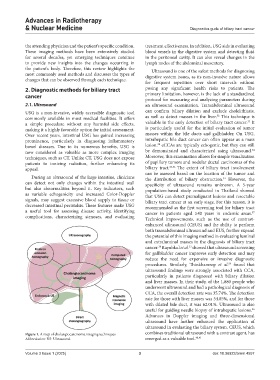
            Figure 1. A map of cholangiocarcinoma imaging techniques  combines traditional ultrasound with a contrast agent, has
            Abbreviation: US: Ultrasound.                      emerged as a valuable tool. 40,41


            Volume 3 Issue 1 (2025)                         3                              doi: 10.36922/arnm.4557

