


Page 17 - ARNM-3-1
P. 17
Advances in Radiotherapy
            & Nuclear Medicine                                                    Diagnostics gude of biliary tract cancer


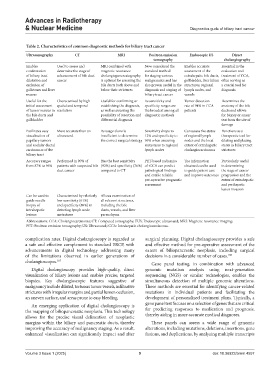
            Table 2. Characteristics of common diagnostic methods for biliary tract cancer
            Ultrasonography      CT                MRI          Positron emission   Endoscopic US   Direct
                                                                  tomography                    cholangiography
            Enables      Used to assess and   MRI combined with   Now considered the   Enables accurate   Essential in the
            confirmation   determine the stage of   magnetic resonance   standard method   assessment of the   evaluation and
            of biliary tract   advancement of bile duct   cholangiopancreatography  for staging various   extrahepatic bile ducts,  treatment of CCA,
            dilatation and   cancer         is optimal for assessing the  malignancies and has   gallbladder, liver hilum  often serving as
            exclusion of                    bile ducts both above and   also proven useful in the  structures, regional   a crucial tool for
            gallstones and liver            below their strictures  diagnosis and staging of  lymph nodes, and   diagnosis
            masses                                             biliary tract cancer  vessels
            Useful for the   Characterized by high   Useful for confirming or   Its sensitivity and   Tumor detection   Determines the
            initial assessment  spatial and temporal   establishing the diagnosis,   specificity ranges are   rate of 94% in CCA   anatomy of the bile
            of tumor masses in  resolution  as well as assessing the   the broadest among all   patients  ducts and allows
            the bile ducts and              possibility of resection and  diagnostic methods   for biopsy or smear
            gallbladder                     differential diagnosis                             test from the site of
                                                                                               damage
            Facilitates easy   More accurate than an   Its usage alone is   Sensitivity drops to   Can assess the status   Functions as a
            visualization of   ultrasound   insufficient to determine   12% and specificity to   of regional lymph   therapeutic tool for
            papillary tumors                the correct surgical strategy 96% when assessing   nodes and the local   dilating and placing
            and nodular ductal                                 metastases to regional   extent of extrahepatic  stents in biliary tract
            carcinomas of the                                  lymph nodes     cholangiocarcinoma  strictures
            biliary tract
            Accuracy ranges   Performed in 90% of   Has the best sensitivity   PET-based radiomics   The information   Particularly useful
            from 87% to 96%  patients with suspected bile  (92%) and specificity (76%)  of iCCA can predict   obtained can be used   in determining
                         duct cancer        compared to CT     pathological findings   to guide patient care   the stage of cancer
                                                               and enable reliable   and improve outcomes progression and the
                                                               pre-operative prognostic        extent of extrahepatic
                                                               assessment                      and perihepatic
                                                                                               lesion invasion
            Can be used to   Characterized by relatively  Allows examination of
            guide needle   low sensitivity (61%)   all relevant structures,
            biopsy of    and specificity (88%) in   including the bile
            intrahepatic   detecting lymph node   ducts, vessels, and liver
            lesions      metastases         parenchyma
            Abbreviations: CCA: Cholangiocarcinoma; CT: Computed tomography; EUS: Endoscopic ultrasound; MRI: Magnetic resonance imaging;
            PET: Positron emission tomography; US: Ultrasound; iCCA: Intrahepatic cholangiocarcinoma.


            complication rates. Digital cholangioscopy is regarded as   surgical planning. Digital cholangioscopy provides a safe
            a safe and effective complement to standard ERCP, with   and effective method for pre-operative assessment of the
            advancements  in  digital  technology  addressing  many   extent of biliopancreatic neoplasia, including surgical
            of the limitations observed in earlier generations of   decisions in a considerable number of cases. 108
            cholangioscopes. 107                                 Gene panel testing, in combination with advanced
              Digital cholangioscopy provides high-quality, direct   genomic mutation analysis using next-generation
            visualization of biliary lesions and enables precise, targeted   sequencing (NGS) or similar technologies, enables the
            biopsies. Key cholangioscopic features suggestive of   simultaneous  detection  of  multiple  genomic  alterations.
            malignancy include dilated, tortuous tumor vessels, infiltrative   These methods are essential for identifying cancer-related
            strictures with irregular margins and partial lumen occlusion,   mutations  in individual  patients  and  facilitating  the
            an uneven surface, and areas prone to easy bleeding.  development of personalized treatment plans. Typically, a
              An emerging application of digital cholangioscopy is   gene panel test focuses on a selection of genes that are critical
            the mapping of biliopancreatic neoplasia. This technology   for predicting responses to medication and prognosis,
            allows  for  the  precise  visual  delineation  of  neoplastic   thereby aiding in more accurate medical diagnoses.
            margins within the biliary and pancreatic ducts, thereby   These panels can assess a wide range of genomic
            improving the accuracy of malignancy staging. As a result,   alterations, including mutations, deletions, insertions, gene
            enhanced visualization can significantly impact and alter   fusions, and duplications, by analyzing multiple transcripts


            Volume 3 Issue 1 (2025)                         9                              doi: 10.36922/arnm.4557

