


Page 120 - DP-2-1
P. 120
Design+                                                    Feasibility of shell fusion technology in jewelry design


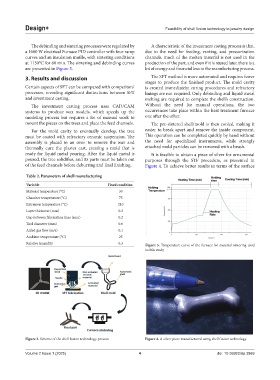
              The debinding and sintering processes were regulated by   A characteristic of the investment casting process is that,
            a 1600 W electrical Furnace PID controller with four ramp   due to the need for feeding, venting, and pressurization
            curves and an insulation muffle, with sintering conditions   channels, much of the molten material is not used in the
            at 1130°C for 60 min. The sintering and debinding curves   production of the part, and even if it is reused later, there is a
            are presented in Figure 3.                         lot of energy and financial loss in the manufacturing process.

            3. Results and discussion                            The SFT method is more automated and requires fewer
                                                               stages to produce the finished product. The mold cavity
            Certain aspects of SFT can be compared with competitors’   is created immediately; curing procedures and refractory
            processes, revealing significant distinctions between SFT   linings are not required. Only debinding and liquid metal
            and investment casting.                            melting are required to complete the shell’s construction.
              The  investment  casting  process  uses  CAD/CAM   Without the need for manual operations, the two
            systems to produce wax models, which speeds up the   occurrences take place within the heat treatment furnace
            modeling process but requires a lot of manual work to   one after the other.
            mount the pieces on the trees and place the feed channels.  The pre-sintered shell/mold is then cooled, making it
              For the mold cavity to eventually develop, the tree   easier to break apart and remove the inside component.
            must be coated with refractory ceramic suspension. The   This operation can be completed quickly by hand without
            assembly  is  placed in  an  oven  to  remove  the  wax  and   the need for specialized instruments, while strongly
            thermally cure the plaster cast, creating a mold that is   attached mold particles can be removed with a brush.
            ready for liquid metal pouring. After the liquid metal is   It is feasible to obtain a piece of silver for ornamental
            poured, the tree solidifies, and its parts must be taken out   purposes  through  the  STF  procedure,  as  presented  in
            of the feed channels before deburring and final finishing.  Figure 4. To achieve better results in terms of the surface

            Table 2. Parameters of shell manufacturing
            Variable                           Fixed condition
            Material temperature (°C)               30
            Chamber temperature (°C)                75
            Extrusion temperature (°C)             210
            Layer thickness (mm)                   0.2
            Gap between fabrication lines (mm)     0.2
            Tool diameter (mm)                     0.6
            Aided gas flow (m/s)                   0.1
            Ambient temperature (°C)                25
            Relative humidity                      0.3         Figure 3. Temperature curve of the furnace for material sintering used
                                                               in this study


            Figure 2. Scheme of the shell fusion technology process  Figure 4. A silver piece manufactured using shell fusion technology


            Volume 2 Issue 1 (2025)                         4                                doi: 10.36922/dp.3869

