


Page 10 - EER-2-1
P. 10
Explora: Environment
            and Resource                                                        Data should determine biocontrol success


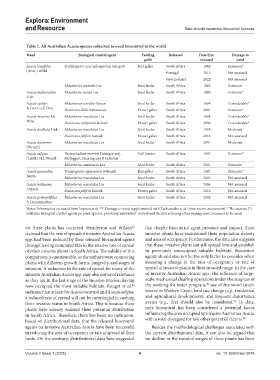
            Table 1. All Australian Acacia species subjected to weed biocontrol in the world
            Weed                  Biological control agent   Feeding     Released     Date first    Damage to
                                                              guild                   released        weed
            Acacia longifolia   Trichilogaster acaciaelongifoliae (Frogatt)  Bud galler  South Africa  1982  Extensive*
            (Andr.) Willd.                                              Portugal       2015       Not assessed
                                                                        New Zealand    2022       Not assessed
                            Melanterius ventralis Lea       Seed feeder  South Africa  1985       Extensive
            Acacia melanoxylon   Melanterius acacia Lea     Seed feeder  South Africa  1986       Extensive*
            R.Br.
            Acacia cyclops   Melanterius servulus Pascoe    Seed feeder  South Africa  1994       Considerable*
            A.Cunn.exG.Don  Dasineura dielsi Rübsaamen      Flower galler  South Africa  2001     Extensive*
            Acacia mearnsii De   Melanterius maculatus Lea  Seed feeder  South Africa  1994       Considerable*
            Wild.           Dasineura rubiformis Kolesik    Flower galler  South Africa  2006     Considerable*
            Acacia dealbata Link  Melanterius maculatus Lea  Seed feeder  South Africa  1998      Moderate
                            Dasineura pilifera Kolesik      Flower galler  South Africa  2016     Not assessed
            Acacia decurrens   Melanterius maculatus Lea    Seed feeder  South Africa  2001       Moderate
            (Wendl.)
            Acacia saligna   Uromycladium morrisii Doungsa-ard,   Gall former  South Africa  1987  Extensive*
            (Labill.) H.L.Wendl.  McTaggart, Geering and R.G.Shivas
                            Melanterius castanaeus Lea      Seed feeder  South Africa  2001       Extensive
            Acacia pycnantha   Trichilogaster signiventris (Girault)  Bud galler  South Africa  1987  Extensive*
            Benth.          Melanterius maculatus Lea       Seed feeder  South Africa  2003       Not assessed
            Acacia baileyana   Melanterius maculatus Lea    Seed feeder  South Africa  2006       Not assessed
            F.Muell.        Dasineura pilifera Kolesik      Flower galler  South Africa  2016     Not assessed
            Acacia podalyriifolia   Melanterius maculatus Lea  Seed feeder  South Africa  2008    Not assessed
            A.CunnexG.Don
            Notes: Information extracted from Impson et al.  10,31  Damage to weed supplemented with Zachariades et al. (most recent assessment).  The asterisk (*)
                                                                                                 12
            indicates biological control agents on plant species, providing ‘substantial’ control and thereby reducing other management measures to be used.

            for these plants has occurred. Henderson and Wilson    that despite biocontrol agent presence and impact, these
                                                         30
            claimed that the rate of spread of invasive Australian Acacia   invasive plants have maintained their population density
            spp. had been reduced by their released biocontrol agents   and area of occupancy. Furthermore, the data also suggests
            through having compared this to the relative rate of spread   that these invasive plants can still spread into and establish
            of other invasive plants in South Africa. The validity of this   in previously unoccupied suitable habitats. Biocontrol
            comparison is questionable, as the authors were comparing   agents should also not be the only factor to consider when
            plants with different growth forms, longevity, and stages of   assessing  a  change  in  the  area  of  occupancy  or  rate  of
            invasion. A reduction in the rate of spread for many of the   spread of invasive plants in their invaded range. In the case
            invasive Australian Acacia spp. may also not be of relevance   of invasive Australian Acacia spp., the influence of large-
            as they are in the last stage of the invasive process, having   scale mechanical clearing operations under the auspices of
                                                                                         28
            now occupied the most suitable habitats. Rouget  et al.    the working for water program,  use of fire wood (main
                                                         38
            indicated that at least for Acacia mearnsii and Acacia saligna,   source in Western Cape), land use change (e.g., residential
            a reduced rate of spread will not be meaningful in curbing   and agricultural development), and frequent disturbance
                                                                                                    39
            their invasive status in South Africa. This is because these   events (e.g., fire) should also be considered.  To date,
            plants have already realized their potential distribution   only biocontrol has been considered a potential factor
            in South Africa. Therefore, there has been no indication,   influencing the area occupied by invasive Australian Acacia
            based on distributional data, that the released biocontrol   with a total disregard for any other potential factors. 30
            agents on invasive Australian Acacia have been successful   Besides the methodological challenges associated with
            in reducing the area of occupancy or rate of spread of their   the current distributional data, it can also be argued that
            hosts. On the contrary, distributional data have suggested   no decline in the invaded ranges of these plants has been


            Volume 2 Issue 1 (2025)                         4                                doi: 10.36922/eer.5876

