


Page 11 - EER-2-1
P. 11
Explora: Environment
            and Resource                                                        Data should determine biocontrol success


            observed due to a possible latency to the observed change   At present, only one investigation was made during
            in the area occupied.  This view is based on most of the   the same season on most of the seed bank dynamic stages
                             16
            released agents being seed-reducing agents which do not   of three of the worst invasive Australian  Acacia spp. in
            directly influence plant occupancy. Rather, the agents   South Africa (i.e.,  Acacia longifolia,  A. pycnantha, and
            have an indirect effect through influencing the rate of   A.  saligna). 13-15   This  investigation  was  done  many  years
            recruitment into existing and new populations. Therefore,   after the biocontrol programs on these invasive Acacia spp.
            studies on the plant’s seed bank dynamics are required   were declared successful. 8-10,12  Studies by Strydom  et al.
            to assess whether any changes in the long term can be   (covering all aspects of these species’ reproductive cycle)
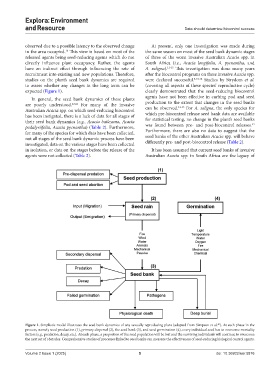
            expected (Figure 1).                               clearly demonstrated that the seed-reducing biocontrol

              In  general,  the  seed  bank  dynamics of  these plants   agents have not been effective in curbing pod and seed
            are poorly understood. 27,41  For many of the invasive   production to the extent that changes in the seed banks
                                                                             13-15
            Australian Acacia spp. on which seed-reducing biocontrol   can be observed.   For  A. saligna, the only species for
            has been instigated, there is a lack of data for all stages of   which pre-biocontrol release seed bank data are available
            their seed bank dynamics (e.g., Acacia baileyana, Acacia   for statistical testing, no change in the plant’s seed banks
                                                                                                            13
            podalyriifolia, Acacia pycnantha) (Table 2). Furthermore,   was found between pre-  and post-biocontrol releases.
            for many of the species for which data have been collected,   Furthermore, there are also no data to suggest that the
            not all stages of the seed bank dynamic process have been   seed banks of the other Australian Acacia spp. will behave
            investigated, data on the various stages have been collected   differently pre- and post-biocontrol release (Table 2).
            in isolation, or data on the stages before the release of the   It has been assumed that current seed banks of invasive
            agents were not collected (Table 2).               Australian  Acacia  spp.  in  South  Africa  are  the  legacy  of


            Figure 1. Simplistic model illustrates the seed bank dynamics of any sexually reproducing plant (adapted from Simpson et al. ). At each phase in the
                                                                                              40
            process, namely seed production (1), primary dispersal (2), the seed bank (3), and seed germination (4), every individual seed has to overcome mortality
            factors (e.g., predation, decay, etc.). At each phase, a proportion of the seed population will be lost and the surviving individuals will continue to overcome
            the next set of obstacles. Comprehensive studies of processes linked to seed banks can measure the effectiveness of seed-reducing biological control agents.

            Volume 2 Issue 1 (2025)                         5                                doi: 10.36922/eer.5876

