


Page 17 - EER-2-1
P. 17
Explora: Environment
            and Resource                                                        Data should determine biocontrol success


            have increased the complexity of managing  A. saligna.   Another seed-reducing agent, the flower-bud galling
            Impson et al.  have similarly argued that the gall midge   wasp Trichilogaster acaciaelongifoliae Froggatt (Figure 4),
                       16
            Dasineura dielsi  (Cecidomyiidae)  has  caused  a  decline  in   was found to reduce the reproductive potential of
            tree density of Acacia cyclops before and after fire events.   A.  longifolia  (Andr.)  Wild  within  the  first  few  years  of
            However, they have not indicated the area covered by the   introduction at several sites within South Africa, although
            plant, and consequently, the extent to which this agent will   mostly  sampling  concentrated within the Western and
            cause a decline in the area occupied by A. cyclops is unclear.  Eastern Cape. 80,82,83  However, since the introduction of this
                                                               agent on A. longifolia, there have been no direct measures
             A                       B                         of this invasive plant’s abundance and distribution
                                                               after 25  years of biocontrol.  Using scale-area curves,
                                                                                       10
                                                               Veldtman  et al.  showed that  A. longifolia indeed has
                                                                            115
                                                               variable tree density across its geographic range but that
                                                               T. acaciaelongifoliae is present everywhere throughout this
                                                               range.  They  suggest  that  A. longifolia  is  a  niche-limited
                                                               invasive weed species in South Africa and that propagule
                                     C                         reduction will  not enforce a  range limit  but rather  as
                                                               a consequence of a combination of a lack of favorable
                                                               vegetation type and climatic suitability for the invasive
                                                               plant itself.  Using the climatic modeling by Rouget et al.
                                                                        115
                                                                                                            38
                                                               to project the potential distribution of A. longifolia thus
                                                               overestimates the potential range by not taking soil types
                                                               into account. Therefore, by comparing the realized range
                                                               to the overestimated potential distribution, the proposed
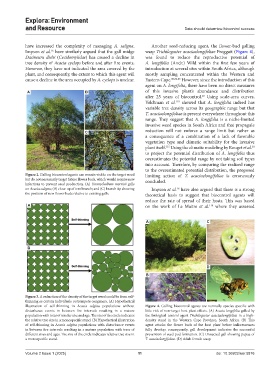
            Figure 2. Galling biocontrol agents can remain visible on the target weed   limiting action of  T. acaciaelongifoliae is erroneously
            but do not necessarily target future flower buds, which would require new   concluded.
            infections to prevent seed production. (A) Uromycladium morrisii galls
            on Acacia saligna; (B) close-up of tree branch; and (C) branch tip showing   Impson et al.  have also argued that there is a strong
                                                                            16
            the position of new flower buds relative to existing galls.  theoretical basis to suggest that biocontrol agents will
                                                               reduce the rate of spread of their hosts. This was based
             A                                                 on the work of Le Maitre  et al.  where they assessed
                                                                                          116

                                                               A                         C


             B


                                                                                         D
                                                               B


            Figure 3. A reduction of the density of the target weed could be from self-
            thinning as certain individuals outcompete congeners. (A) Hypothetical
            illustration of self-thinning in  Acacia  salgina  populations without   Figure  4.  Galling biocontrol agents are normally species-specific with
            disturbance  events  in  between  fire  intervals  resulting  in  a  mature   little risk of non-target host plant effects. (A) Acacia longifolia galled by
            population with trees of similar size and age. The size of the circle indicates   the biological control agent  Trichilogaster acaciaelongifoliae in a high-
            the relative tree size in a monospecific stand. (B) Hypothetical illustration   density stand in the Western Cape Province, South Africa. (B) This
            of  self-thinning  in  Acacia salgina  populations  with  disturbance  events   agent attacks the flower buds of the host plant before inflorescences
            in between fire intervals resulting in a mature population with trees of   fully develop; consequently, gall development indicates the successful
            different sizes and ages. The size of the circle indicates relative tree size in   prevention of seed pod formation. (C) Dissected gall showing pupae of
            a monospecific stand.                              T. acaciaelongifoliae. (D) Adult female wasp.


            Volume 2 Issue 1 (2025)                         11                               doi: 10.36922/eer.5876

