


Page 18 - EER-2-1
P. 18
Explora: Environment
            and Resource                                                        Data should determine biocontrol success


            the potential impact of biocontrol on the population   the efficacy of clearing operations on invasive Australian
            dynamics and rate of spread of Hakea sericea. However,   Acacia spp. and who concluded “Even reducing plants to
            Le Maitre et al.  used the opinion of “experts” to discern   <1 plant per hectare (our aim) would leave a few scattered
                        116
            possible dispersal distances of this plant in the presence   plants capable of seeding on the landscape, which could lead
            of  its  biocontrol  agent.  The  theory  is,  therefore,  largely   to problematic regeneration relatively quickly.”
            influenced by expert opinion rather than quantitative   Despite these limitations, the release of gall-forming
            data and, therefore, subject to possible bias. Regardless,   and seed-feeding agents was promoted as the best strategy
            it is questionable to use the modeled dynamics (which is   to control the invasion of Australian Acacia spp. in South
            an approximation of reality) of one species and growth   Africa while not impacting their economic use. 28,32,119
            form and agent combination to make a case for another   Arguably, this “win-win” approach has led to a suboptimal
            biocontrol test case. The question should be asked why basic   management decision – do not attempt to control
            information, such as the rate of spread of A. cyclops or any   vegetative growth but rather target the reproductive output
            other Acacia spp., was never collected. Any appropriately   of the tree. However, has there ever been a case where
            collected and analyzed data will provide far more support   >99.9% of the reproductive output of invasive plants has
            than modeled dynamics based on parameters derived from   been reduced by a released agent? A more realistic figure
            expert opinion.                                    would be a 50% reduction of seeds. 14,15  However, Australian
                                                                                                           2
            3. How much is enough?                             Acacia spp. are not seed-limited and 1 seed per m  is
                                                               sufficient to maintain cover after disturbance (Table 4).
            Irrespective of whether seed production, seed bank size,   Strydom  et al. 13,14  documented seed production per m
                                                                                                             2
            or rate of spread has changed, the pertinent question that   with established agents much greater than the few seeds
            should be asked is how much reproductive output must   required (140 – 350 seeds per m ). This critique specifically
                                                                                        2
            be reduced to have an appreciable impact on the area of   addresses the use of seed-reducing agents in the control of
            occupancy,  rate  of  spread,  and  management  costs.  To   Australian Acacia spp. and we are not aware of any released
            reduce a plant population’s area of occupancy, seed input   biological control agents used for attacking the vegetative
            needs to be reduced below the carrying capacity of mature   parts of these invasive plants. We can thus not say whether
            populations.  In this situation, density-dependent seedling   the use of the latter would be more effective. Our argument
                      117
            mortality will not be able to compensate for the differences   instead is that seed reduction of Australian Acacia spp. is
                            117
            in seedling densities.  Therefore, the population needs to   unlikely to be effective given the biological response of the
            be seed-limited for seed-reducing agents to be effective. 118  released agents and the fact that these plants are not seed-
              Considering the carrying capacity and seed bank size   limited. Data on whether agents targeting reproductive or
            of mature invasive Australian Acacia spp. populations in   vegetative parts would be more effective for other plant
            the presence of their released biocontrol agents in South   species would not be relevant here because we are not
            Africa, their associated seed-reducing biocontrol agents   making general statements on the effectiveness of different
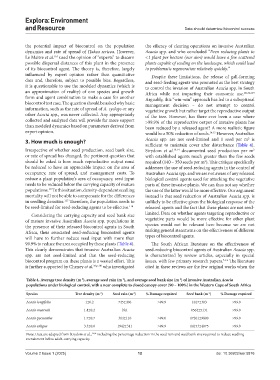
            will  have  to  further  reduce  seed  input  with  more  than   types of biocontrol agents.
            99.9% to reduce the area occupied by these plants (Table 4).   The South African literature on the effectiveness of
            This clearly demonstrates that invasive Australian Acacia   seed-reducing biocontrol agents of Australian Acacia spp.
            spp. are not seed-limited and that the seed-reducing   is characterized by review articles, especially in special
            biocontrol program on these plants is a wasted effort. This   issues, with few primary research papers. 5-12  The literature
            is further supported by Cheney et al. 33,p.281  who investigated   cited in these reviews are the few original works when the


            Table 4. Average tree density (m ), average seed rain (m ), and average seed bank size (m ) of invasive Australian Acacia
                                    ‑2
                                                     ‑2
                                                                             ‑2
            populations under biological control, with a near complete to closed canopy cover (90 – 100%) in the Western Cape of South Africa
            Species              Tree density (m )  Seed rain (m )  % Damage required  Seed bank (m )  % Damage required
                                                                                         ‑2
                                                          ‑2
                                           ‑2
            Acacia longifolia        1±0.2         745±406          >99.9          1017±303         >99.9
            Acacia mearnsii          1.4±0.2         NA                           8564±5131         >99.9
            Acacia pycnantha         1.7±0.7       314±110          >99.0         17261±9800        >99.9
            Acacia saligna           3.3±0.8       1942±311         >99.9         14153±4075        >99.9
            Note: Data are adapted from Strydom et al., 13,14  including the percentage reduction in the seed rain and seed bank size required to reduce seedling
            recruitment below adult-carrying capacity.


            Volume 2 Issue 1 (2025)                         12                               doi: 10.36922/eer.5876

