


Page 136 - EER-2-2
P. 136
Explora: Environment
            and Resource                                                                Tourism resources of Xinjiang


            a few home-visit-style tours cause a significant portion of   Xinjiang’s rivers, such as the Irtysh River and Ili
            income to be directed to tourism companies.  Several 3A   River, add unique scenic value to the spots. Sayram Lake,
                                                17
            and 4A-level attractions lack subsequent development and   renowned for its stunning high-altitude lake landscape,
            investment, making it difficult to develop and utilize their   has become a haven for photographers. At the same time,
            tourism resources fully. 5                         Tianchi  Lake  in  the  Tianshan  Mountains  attracts  many
                                                               visitors with its clear waters and surrounding forested
            3.1.2. Altitudinal distribution characteristics of   mountains.  There  is a  certain relationship  in the  spatial
            tourism destinations                               distribution between Xinjiang’s rivers and tourism

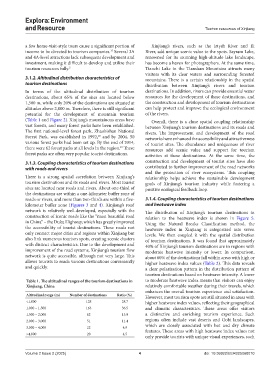
            In terms of the altitudinal distribution of tourism   destinations. In addition, rivers can provide essential water
            destinations, about 65% of the sites are located below   resources for the development of these destinations, and
            1,500 m, while only 20% of the destinations are situated at   the construction and development of tourism destinations
            altitudes above 2,000 m. Therefore, there is still significant   can help protect and improve the ecological environment
            potential for the development of mountain tourism   of the rivers.
            (Table 1 and Figure 2). Xinjiang’s mountainous areas have   Overall, there is a close spatial coupling relationship
            vast forests, and many forest parks have been established.   between Xinjiang’s tourism destinations and its roads and
            The first national-level forest park, Zhaobishan National   rivers. The improvement and development of the road
            Forest  Park,  was  established  in  1992,   and  by  2004,  50   networks have enhanced the accessibility and attractiveness
                                           18
            various forest parks had been set up. By the end of 2014,   of  tourist  sites.  The  abundance  and  uniqueness  of  river
            there were 62 forest parks at all levels in the region.  These   resources add scenic value and support for tourism
                                                    19
            forest parks are often very popular tourist destinations.  activities  at these destinations.  At the  same  time,  the
            3.1.3. Coupling characteristics of tourism destinations   construction and development of tourist sites have also
            with roads and rivers                              contributed to further improvement of the road networks
                                                               and the protection of river ecosystems. This coupling
            There is a strong spatial correlation between Xinjiang’s   relationship helps achieve the sustainable development
            tourism destinations and its roads and rivers. Most tourist   goals of Xinjiang’s tourism industry while fostering a
            sites are located near roads and rivers. About one-third of   positive ecological feedback loop.
            the destinations are within a one-kilometer buffer zone of
            roads or rivers, and more than two-thirds are within a five-  3.1.4. Coupling characteristics of tourism destinations
            kilometer buffer zone (Figures  3 and  4). Xinjiang’s road   and heatwave index
            network is relatively well-developed, especially with the   The distribution of Xinjiang’s tourism destinations in
            construction of iconic roads like the “most beautiful road   relation to the heatwave index is shown in  Figure  5.
            in China” – the Duku Highway, which has greatly improved   Using the Natural Breaks Classification method, the
            the accessibility of tourist destinations. These roads not   heatwave index in Xinjiang is categorized into seven
            only connect major cities and regions within Xinjiang but   levels. We then coupled it with the spatial distribution
            also link numerous tourism spots, creating scenic clusters   of tourism destinations. It was found that approximately
            with distinct characteristics. Due to the development and   40% of Xinjiang’s tourism destinations are in regions with
            improvement of the road systems, Xinjiang’s tourism flow   moderate heatwave intensity or lower. In comparison,
            network is quite accessible, although not very large. This   about 60% of the destinations fall within areas with high or
            allows tourists to reach various destinations conveniently   higher heatwave index values (Table 2). This data reveals
            and quickly.                                       a clear polarization pattern in the distribution pattern of
                                                               tourism destinations based on heatwave intensity. A lower
            Table 1. The altitudinal ranges of the tourism destinations in   to moderate heatwave index means that visitors can enjoy
            Xinjiang, China                                    relatively comfortable weather during their travels, which
                                                               enhances the overall tourism experience and satisfaction.
            Altitudinal range (m)  Number of destinations  Ratio (%)  However, most tourism spots are still situated in areas with
            <1,000                    128            28.7      higher heatwave index values, reflecting their geographical
            1,000 – 1,500             163            36.5      and climatic characteristics. These areas offer visitors
            1,500 – 2,000             62             13.9      a distinctive and enriching tourism experience. Such
            2,000 – 3,000             51             11.4      regions often include vast deserts and Gobi landscapes,
            3,000 – 4,000             22             4.9       which are closely associated with hot and dry climate
                                                               features. These areas with high heatwave index values not
            >4,000                    20             4.5
                                                               only provide tourists with unique visual experiences, such


            Volume 2 Issue 2 (2025)                         4                           doi: 10.36922/EER025060010

