


Page 139 - EER-2-2
P. 139
Explora: Environment
            and Resource                                                                Tourism resources of Xinjiang


            Table 2. The number and proportion of tourism destinations   4. Suggestions on tourism development in
            in each heatwave index level in Xinjiang, China    Xinjiang
            Heatwave index level  Number of destinations  Ratio (%)  4.1. The development of mountain and forest
            The lowest                9              1.86      tourism
            Lower                     23             4.75      Xinjiang’s mountain and forest tourism is highly distinctive.
            Low                       62             12.81     However, most existing destinations are located at lower
            Medium                    108            22.31     altitudes, with over 60% of them being below 1,500 m. There
            High                      90             18.60     is significant potential to develop higher-altitude mountain
            Higher                    76             15.70     and forest tourism, particularly in regions where the heat
            The highest               116            23.97     levels are relatively lower, providing more comfortable
                                                               experiences. After years of development, Xinjiang’s forest
                                                               tourism has created various types of forest landscapes rich in
                                                               historical relics, cultural sights, and ethnic customs, offering
                                                               unique ecological tourism routes. The development model
                                                               has shifted from passive protection and single-use of forest
                                                                                                    18
                                                               resources to a sustainable development pattern.  According
                                                               to the estimation by Xiong and Qin,  the direct economic
                                                                                            22
                                                               value of Xinjiang’s forests is 920 billion RMB yuan, with the
                                                               recreational value accounting for 68% of the whole direct
                                                               value. Leveraging the newly developed transportation
                                                               networks to promote forest tourism further is a key strategy
                                                               for advancing Xinjiang’s forestry tourism economy.

                                                               4.2. The development of the international market,
                                                               especially the European market

                                                               At present, international tourism revenue in Xinjiang is very
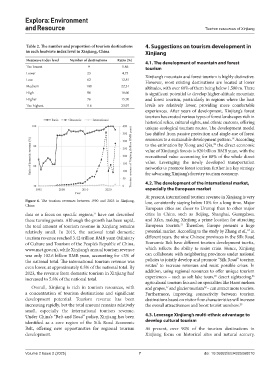
            Figure  6.  The  tourism  revenues  between  1990  and  2023  in  Xinjiang,   low, consistently staying below 10% for a long time. Major
            China
                                                               European cities are closer to Urumqi than to other major
            data or a focus on specific regions,  have not described   cities in China, such as Beijing, Shanghai, Guangzhou,
                                         21
            these turning points. Although the growth has been rapid,   and Xi’an, making Xinjiang a prime location for attracting
                                                                              23
            the total amount of tourism revenue in Xinjiang remains   European tourists.  Therefore, Europe presents a huge
                                                                                                          24
            relatively small. In 2015, the national total domestic   potential market. According to the study by Zhang et al.,  in
            tourism revenue reached 3.42 trillion RMB yuan (Ministry   different years, the nine Chinese provinces in the Silk Road
            of Culture and Tourism of the People’s Republic of China,   Economic Belt have different tourism development inertia,
            www.mct.gov.cn), while Xinjiang’s annual tourism revenue   which reflects the ability to resist crisis. Hence, Xinjiang
            was only 102.6 billion RMB yuan, accounting for <3% of   can collaborate with neighboring provinces under national
            the national total. The international tourism revenue was   policies to jointly develop and promote “Silk Road” tourism
                                                                    7
            even lower, at approximately 0.5% of the national total. By   routes  to increase revenues and resist possible crises. In
            2023, the revenue from domestic tourism in Xinjiang had   addition, using regional resources to offer unique tourism
                                                                                            25
                                                                                                            26
            increased to 5.8% of the national total.           experiences – such as salt lake tours,  desert sightseeing,
                                                               agricultural tourism focused on specialties like Hami melons
              Overall, Xinjiang is rich in tourism resources, with   and grapes,  and glacier tourism – can attract more tourists.
                                                                        27
                                                                                        28
            a concentration of tourism destinations and significant   Furthermore, improving connectivity between tourism
            development  potential.  Tourism  revenue  has  been   destinations based on visitor flow characteristics will increase
            increasing rapidly, but the total amount remains relatively   the overall attractiveness and boost tourist numbers. 29
            small, especially the international tourism revenue.
            Under China’s “Belt and Road” policy, Xinjiang has been   4.3. Leverage Xinjiang’s multi-ethnic advantage to
            identified as a core region of the Silk Road Economic   develop cultural tourism
            Belt, offering new opportunities for regional  tourism   At present, over 90% of the tourism destinations in
            development.                                       Xinjiang focus on historical sites and natural scenery,


            Volume 2 Issue 2 (2025)                         7                           doi: 10.36922/EER025060010

