


Page 71 - EER-2-2
P. 71
Explora: Environment
            and Resource                                                           Application of Algae for seed priming


                             Figure 10. Algal priming affects the rhizosphere by stimulating beneficial microbiome interactions
                                        Abbreviation: PGPR: Plant growth-promoting microorganisms.

            and functionality of PGPR populations, reinforcing early
            root development and health.  In addition, algal extracts
                                    155
            contain B-complex vitamins, which enhance microbial
            metabolism and promote the synthesis of plant-beneficial
            metabolites, such as siderophores and phytohormones.
            Overall, algal priming shapes the rhizosphere microbiome
            in favor of beneficial interactions that underpin healthy
            seedling emergence, robust root establishment, and
            resilience against environmental challenges. 120,156

            7. Algal priming as a sustainable alternative
            for future agriculture
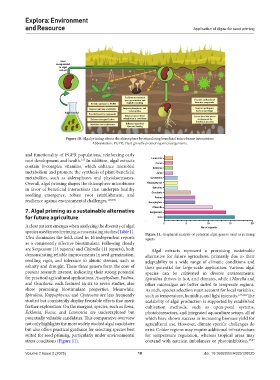
            A clear pattern emerges when analyzing the diversity of algal
            species used in seed priming across existing studies (Table 1).   Figure 11. Graphical analysis of potential algal genera used as priming
            Ulva dominates the field, cited in 16 independent reports   agents
            as a consistently effective biostimulant. Following closely
            are Sargassum (14 reports) and Chlorella (11 reports), both   Algal extracts represent a promising sustainable
            demonstrating reliable improvements in seed germination,   alternative for future agriculture, primarily due to their
            seedling vigor, and tolerance to abiotic stresses, such as   adaptability to a wide range of climatic conditions and
            salinity and drought. These three genera form the core of   their  potential for large-scale  application.  Various algal
            present research interest, indicating their strong potential   species can be cultivated in diverse environments:
            for practical agricultural applications. Ascophyllum, Padina,   Spirulina thrives in hot, arid climates, while Chlorella and
            and Gracilaria, each featured in six to seven studies, also   other microalgae are better suited to temperate regions.
            show promising biostimulant properties. Meanwhile,   As such, species selection must account for local variables,
            Spirulina, Kappaphycus, and Cystoseira are less frequently   such as temperature, humidity, and light intensity. 123,124  The
            studied but consistently display favorable effects that merit   scalability of algal production is supported by established
            further exploration. On the margins, species, such as Jania,   cultivation methods, such as open-pond systems,
            Ecklonia,  Fucus, and  Laurencia are underexplored but   photobioreactors, and integrated aquaculture setups, all of
            potentially valuable candidates. This comparative overview   which have shown success in increasing biomass yield for
            not only highlights the most widely studied algal candidates   agricultural use. However, climate-specific challenges do
            but also offers practical guidance for selecting species best   exist: Colder regions may require additional infrastructure
            suited for seed priming, particularly under environmental   for temperature  regulation, whereas tropical areas  may
            stress conditions (Figure 11).                     contend with nutrient imbalances or photoinhibition. 25,64

            Volume 2 Issue 2 (2025)                         18                          doi: 10.36922/EER025120025

